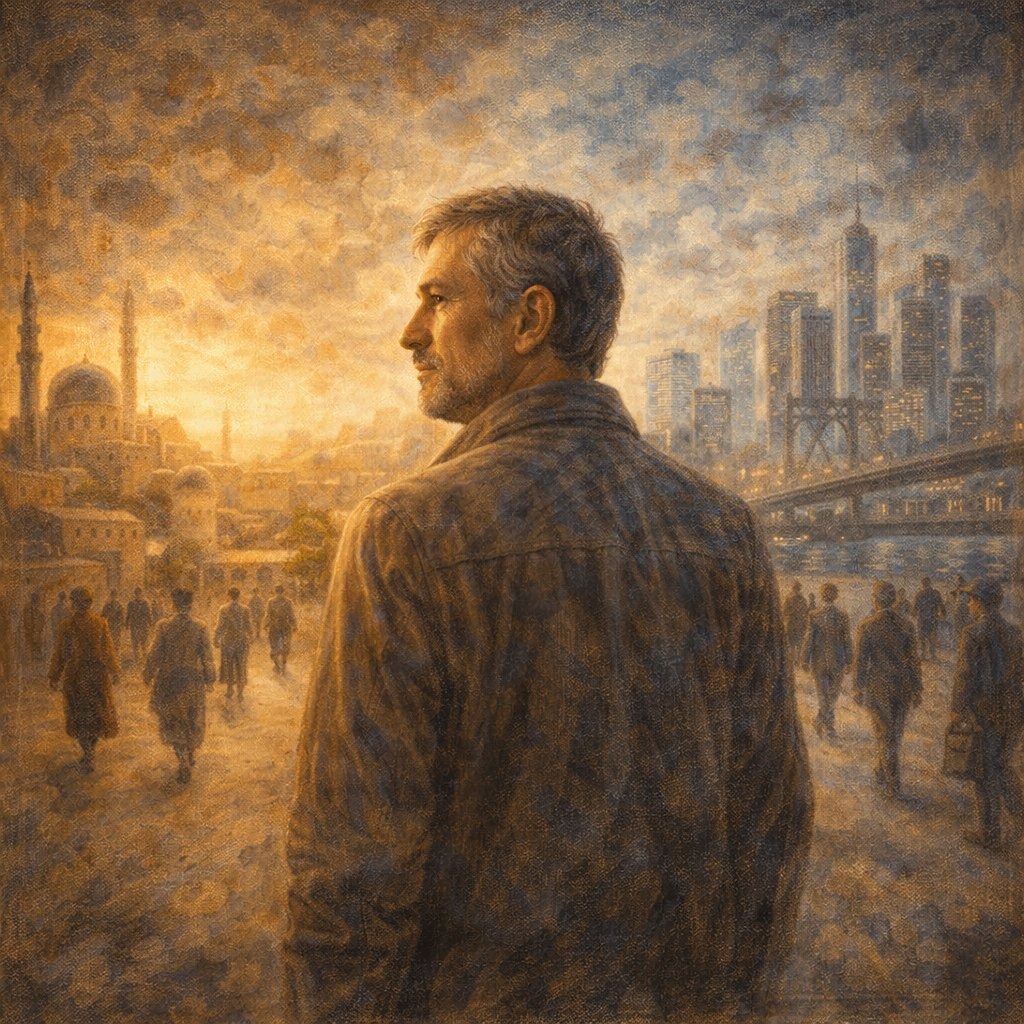
He crossed the sea with a suitcase and a heart full of hope.
The new country welcomed him in its own way, with its language, its streets, its unwritten rules. He worked hard, learned quickly, and blended in until even his accent softened at the edges. For a while, he believed he had become one of them. That the distance between where he came from and where he now stood had quietly closed.
Then came the reminders.
Subtle at first, then sharper. A word dropped lightly: not from here. A glance that said what no one would say aloud: you don't quite belong. Smiles that praised how well he had adapted, yet in their very praise reminded him that adapting was something only outsiders needed to do. He nodded politely each time and carried the weight home in silence, the way people carry things they have no name for yet.
When he returned to his homeland, he thought he would finally rest. That the old streets would receive him the way they always had, without condition or question.
But there too, the words found him. You have changed. You are not quite one of us anymore. His tongue slipped into the new language mid-sentence. His habits had quietly shifted. His presence felt foreign in the place that had raised him, and that strangeness, being a stranger in your own story, was the loneliest kind.
Belonging, it seemed, had two doors. And both were closed.
There were nights he lay awake wondering what he had done wrong. But he had done nothing, except live honestly between two worlds. Even the compliments stung on those nights, the ones about how well he had integrated, how impressive his journey was, because underneath the kindness was always the same quiet message: you are still different.
It took years before understanding arrived, and it arrived not as a revelation but as a quiet settling, the way dust settles after a long disturbance.
He did not have to choose. He did not have to fold himself into one shape or erase the half of him that the other world did not recognise. He belonged to the best of both: the richness of his roots and the growth of his journey. Two languages in his mouth, two cultures in his heart, two ways of seeing the world in his eyes. Not divided, but doubled. Not rejected, but rare.
Yet one thought followed him into his quieter hours, softer than the rest but more persistent.
His children.
He did not want them to inherit the fracture, to grow up carrying that endless, exhausting question of where exactly they belonged. He did not yet know how to protect them from it entirely, or how to teach them to wear it as something to be proud of rather than explained away. He only knew that the question would come for them one day, and that when it did, he wanted to have an answer ready.
So he stood tall, without waiting for either world to grant him permission.
He was not too little in one place or too much in another. He was not a compromise between two identities. He was something neither world had made alone: a man shaped by distance and return, by loss and learning, by the courage it takes to belong nowhere completely and still choose to belong everywhere honestly.
For the first time, he did not feel out of place.
He felt whole.