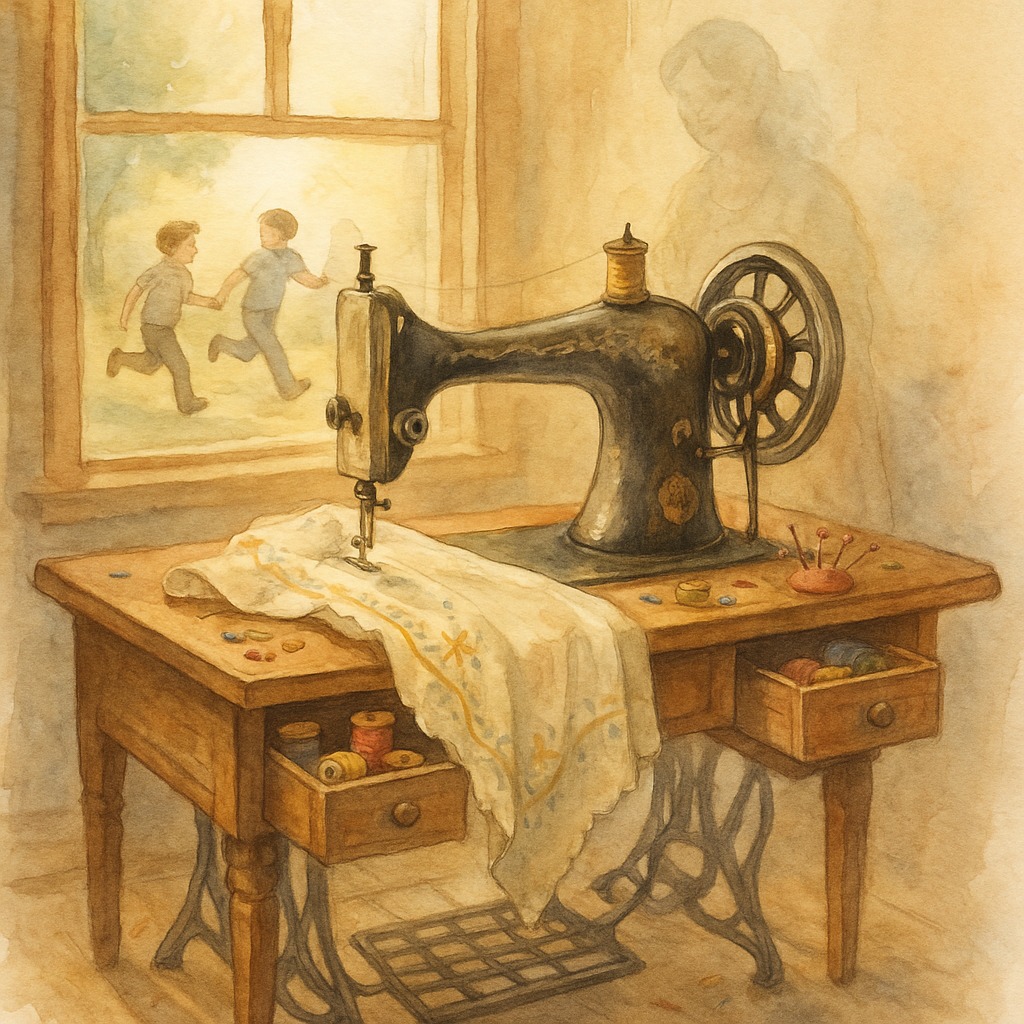
My mother received it as a wedding gift from my grandmother, who reminded her, as tradition demanded, that no bride could begin a family without a sewing machine in her home. For my grandmother, it was not simply a tool. It was a safeguard, a quiet promise that her daughter would be able to mend what broke, create what was needed, and stitch together the fabric of a household with her own hands.
My mother took this to heart. Along with other young brides-to-be, she went to the local tailor after school to learn the art of cutting, patching, and shaping cloth into something new. She learned quickly, and the sewing machine soon became her closest companion. She cherished it so fiercely that my brother and I were forbidden to touch it, which of course meant that we did. We were drawn to its wheels, its tiny drawers filled with colourful threads and sharp pins, and the hum of the pedal as it drove the needle up and down in its even rhythm. That sound was always our betrayal. The moment it echoed through the house, we would scatter, knowing our mother would appear to defend her most treasured possession.
The years passed, as years do.
Our games moved elsewhere, our lives stretched beyond that corner of the house, but the machine never lost its place in her heart. Every day she dusted it, polished its wooden frame, and carefully draped over it a cloth cover she had sewn especially for the purpose.
For us, it had long become part of the furniture, invisible in the way that faithful things become invisible. For her, it remained a partner.
We had stopped noticing everything it had done for us. Trousers shortened, zippers replaced, curtains cut and stitched for every window in the house. We had come to believe, without ever examining the belief, that the machine itself performed the miracles. We forgot that it was our mother's mind guiding every design, her hands steadying every line, her foot pressing the pedal with patience until the cloth yielded to her vision. Machine and woman worked as one, quietly producing what we needed long before we knew we needed it.
In time, my brother and I left home to build our own lives. The machine remained, still waiting in its corner. Each time we visited, our mother would offer to mend something, to make something, to give from her endless resourcefulness. We smiled and declined; told her we could simply buy whatever was missing. We never understood that with each refusal we were turning away from something that could not be bought, the magic that had once clothed us, warmed us, and made our house feel like a home.
Then came the day she was gone.
The machine, stripped of its partner, stood silent. Dust crept into the small drawers and settled around the pedal. Its hum was never heard again. What had been her proudest treasure became a burden to us, heavy with memory yet empty of life. In the end, no collector would take it. Someone carried it away for nothing, not knowing what they held in their hands.
Sometimes, in old photographs, it appears in the background. That strange table with wheels. Our grandchildren ask what it was, and we stumble for words, because how do you explain that it was not a piece of furniture, not even just a machine, but a woman's truest companion? How do you describe the quiet friendship between cloth and metal and human hands, and the dignity that friendship gave to a lifetime of daily labour?
The truth is simple, and I have taken too long to say it.
It was my mother's best friend. And through it, she stitched her love into the fabric of our lives, thread by thread, in ways we only understood after the thread ran out.