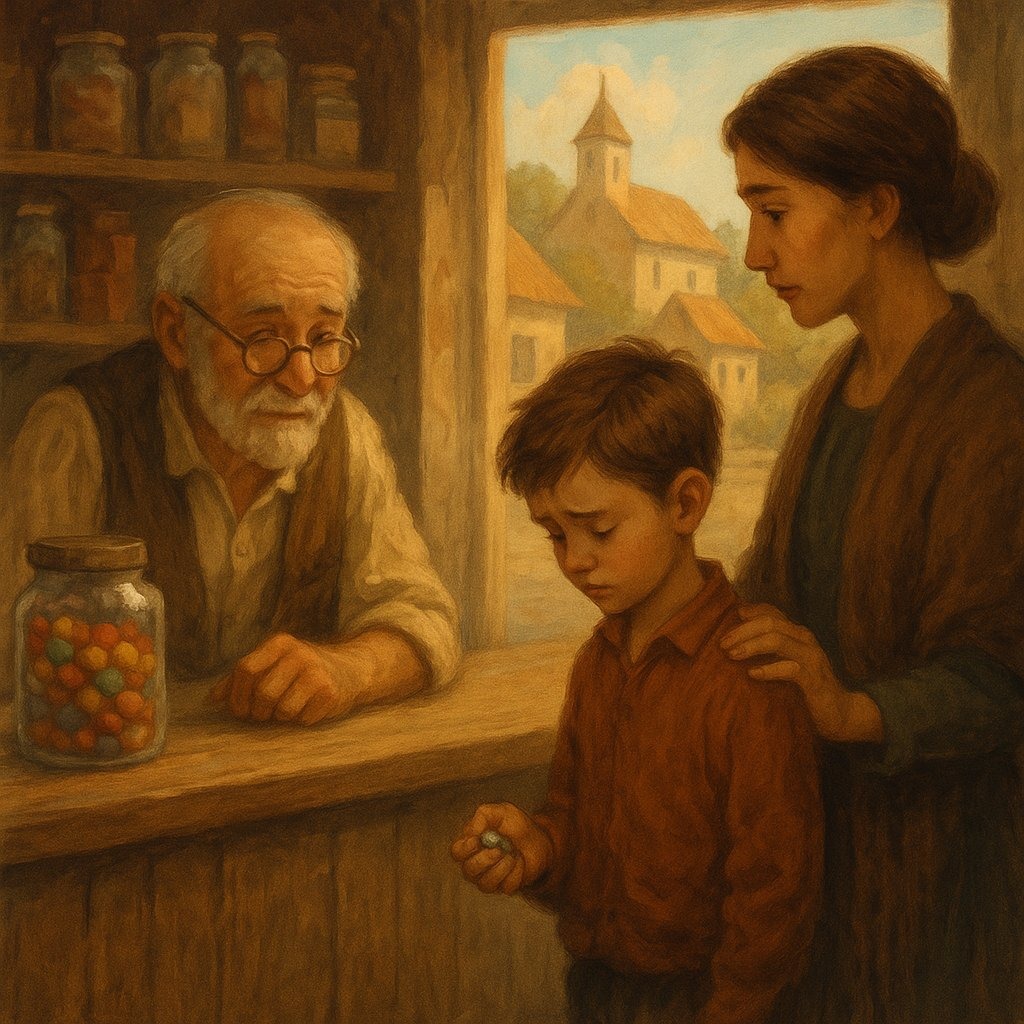
He was still a boy when he first learned the difference between temptation and guilt.
It started with a whisper in the schoolyard; the kind children pass around as though it costs nothing.
His friend leaned close and said, "You can take sweets from the grocery shop. The old man never notices." Then, as proof, he pulled a few from his pocket and grinned.
That evening, the boy could not stop thinking about it. He walked past the shop several times that week. The old man was always there behind the counter, quiet and kind, his eyes weakened by years of working under poor light. He knew every child in the village by name, including him.
One afternoon, his friend went in first. The boy followed.
He watched his friend slip sweets into his jacket, quick and practised. When he whispered, "Is that not stealing?" his friend only shrugged. "It is not stealing if he does not notice."
The boy's heart pounded. He wanted to leave. He also wanted what his friend had, the excitement, the sweets, the feeling of getting away with something. He looked at the old man. When no one was watching, he took a few pieces and walked out.
His hand shook all the way home. The sweets tasted of nothing good. They carried a strange heaviness that had no name yet but that he already did not like.
That evening his mother noticed his silence. She did not ask about sweets. She asked about his day. When he avoided her eyes, she sat beside him and said gently, "You have always been honest with me. What is troubling you?"
Her calm broke through his fear. The story came out in pieces.
He waited for the shouting. It did not come.
She took his hand and was quiet for a moment before she spoke.
"When I was your age," she said, "I took a toy from a friend's house. I told myself it did not matter, that she had so many and would never notice. But I lied about it for weeks, and the lying was heavier than the taking. I lost more than any toy could give me. I lost my peace. That is what stealing truly costs you, not just the person you stole from, but yourself."
He lowered his head. "I am sorry, Mama."
"I know," she said. "But sorry is not enough. Tomorrow you will go back and tell the truth. That is how you make it right."
The next morning, they walked to the shop together. His hands were cold, his steps heavy. He looked at the old man and said quietly, "I took some sweets yesterday. I am sorry. I do not want to be a thief."
The old man placed a hand on his shoulder and smiled. "I know, son. And I am proud you came back. That is how good men are made."
He walked out holding his mother's hand, lighter than he had felt in days.
Years later, when his own son came home with a guilty look and a quiet heart, he did not ask what happened. He simply sat beside him, the way his mother once had, and waited for the truth to find its way home.