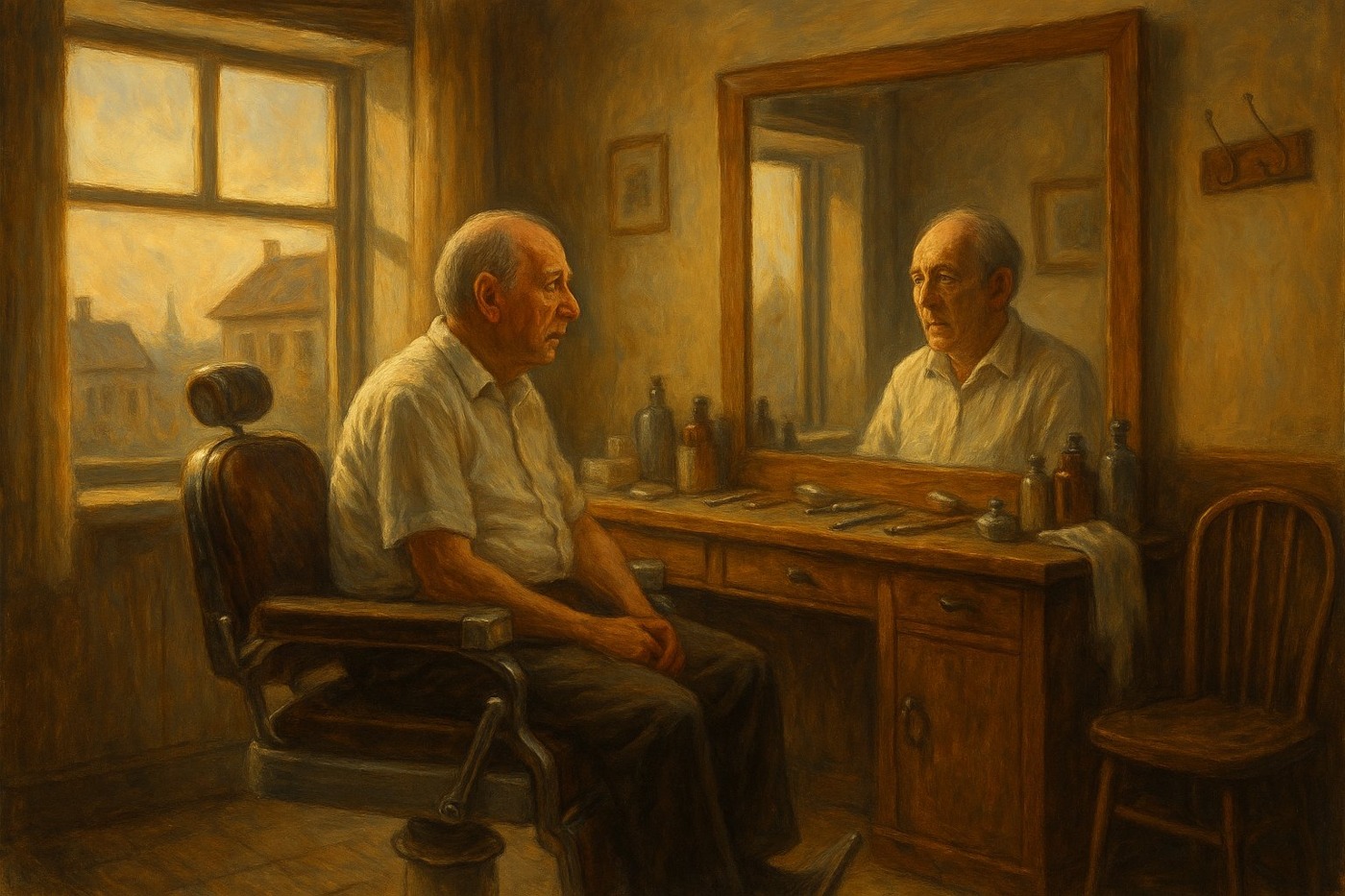
He knew more about the town than anyone else.
Not because he asked, but because people told him.
They talked while he worked, about their children, their neighbours, their dreams, and the things they wished they had not done. He knew who was planning to run for office, who was moving abroad, who was quietly in love, and who was pretending to be fine. He had no need for newspapers. The stories found him.
Men came to his shop not only for a haircut or a shave but for something harder to name, the relief of being heard without judgment. His role was never to argue or advise. He listened, nodded, sometimes smiled. He had spent decades mastering the art of being present without taking up space.
He watched the town change from that chair.
The boys he had once placed on wooden boxes to reach the mirror had become fathers who now brought their own children for their first haircut. Others had gone bald and came less often, joking that he had nothing left to work with. He laughed each time as though it were the first time he had heard it.
But sometimes, when the shop was empty and the last customer had gone, he would look at the mirror and ask himself a question that had no easy answer.
Who listens to the barber?
He had his own worries, his own stories, his own opinions about the world, about people, about the way things were going. But he had spent so many years holding space for others that he had slowly lost the habit of his own voice. He could not remember the last time he had spoken freely, without measuring what the other person needed to hear.
One evening, after sweeping the floor and turning the sign to Closed, he sat down in his own chair.
The smell of shaving cream and aftershave lingered in the still air. The mirror reflected not a customer but himself, older, quieter, but the same man who had spent a lifetime listening to everyone else's lives while his own moved quietly in the background.
He leaned back, folded his arms, and began to talk. Not loudly, not to anyone. Just enough to hear his own voice again. He spoke about his day, his wife, the cost of things, the silence that filled the shop once everyone had gone, and the small satisfactions that he had never thought to mention to anyone because nobody had ever thought to ask.
He did not expect an answer. He did not need one.
Sometimes you do not talk to be understood. You talk simply to let something go.
The chair that had held the weight of everyone else's stories had space for his too. It always had. He had simply never thought to use it.