He used to close his eyes and see it.
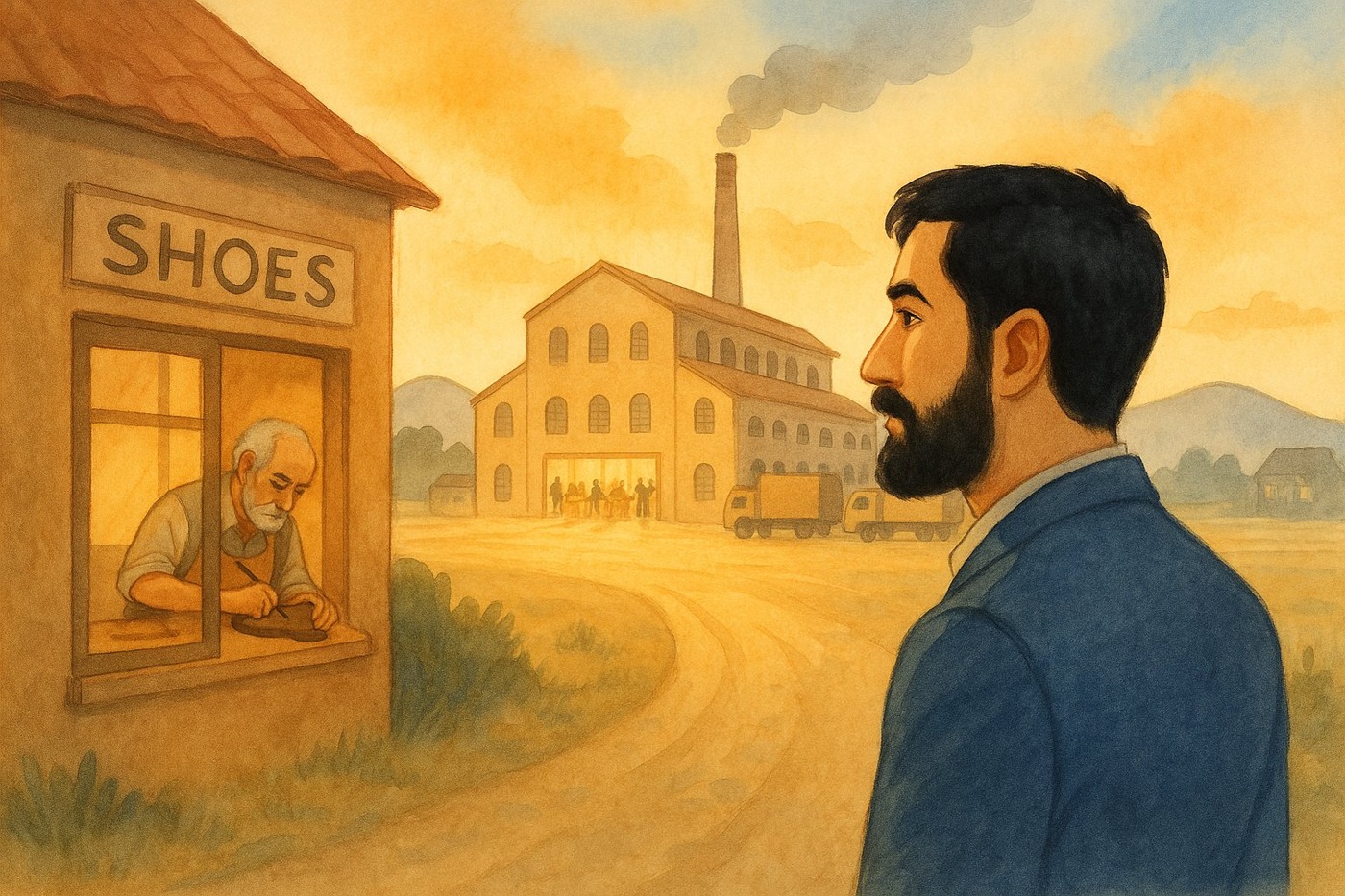
A long building with smoke rising from its roof. Men and women working at rows of tables. Leather stretched on frames, stitching machines humming like music. And outside, trucks loading boxes stamped with his name, not the name of the boy who once polished his father's tools, but the man who turned a vision into something that could walk the world.
His father was a shoemaker, as his father had been before him. Small shop, two chairs, one bench, a dusty window looking onto the street. Every evening the old man would polish the counter and say, "We don't make shoes, son. We make footsteps."
The boy listened and nodded. But he dreamed of more.
He started small, as everyone does. A rented room, a secondhand machine. The first months, nothing worked. The glue would not hold, the suppliers disappeared, and the designs that looked perfect in his mind fell apart in his hands. People laughed, some out of jealousy, others out of genuine concern. Why not simply take over your father's shop, they said.
He smiled but did not answer. He could not explain that he had already seen what he was chasing, and it was too late to unsee it.
Years passed. He survived on stubbornness more than money. There were nights he worked until dawn, fixing broken machines with his bare hands. Mornings when the bills arrived before breakfast and the banks sent nothing but rejection. He sold what he could, borrowed what little remained, and kept going on the kind of faith that has no rational explanation.
Then came the night everything stopped.
The last machine had broken beyond repair. The last supplier had walked away. The last person he had called for help had not called back. He sat alone in the empty workshop, the smell of leather still in the air but nothing left to work with. He looked at the key on the table in front of him.
He picked it up.
He turned it over in his hand for a long time, the way his father used to turn a finished shoe, checking it from every angle before he was satisfied.
And then he thought of the building he had always seen behind his closed eyes. The smoke rising. The machines humming. The trucks lined up outside.
He put the key back down.
Not because anything had changed. Nothing had changed. There was still no money, no supplier, no machine, no reason visible to anyone looking from the outside. He put it down because the vision was still there, and if it was still there, he had not yet arrived at the end.
He would find a way in the morning. He did not know how. He only knew that picking up that key meant admitting the dream had been wrong, and he was not ready to believe that.
He went to sleep on the workshop floor.
What followed was not a miracle. It was work, the same relentless, unglamorous, daily work he had always done, only now with the knowledge of how close he had come to stopping. One small order found its way to him. Then another. A supplier returned. A machine was repaired with parts from two broken ones. Progress came slowly and without ceremony, the way real progress always does.
And one morning, years later, he stood outside at dawn, the building complete at last. The machines were humming inside. The trucks were lined up. His name, worn by strangers on roads he would never walk, had quietly become part of the world.
He ran his hand along the rough wall and closed his eyes.
The building was exactly as he had always seen it.
He had simply refused, on one quiet night with a key in his hand, to stop seeing it.
"I saw you," he said softly. "Long before the world did."