She could have left. Everyone told her to.
Friends, neighbours, even strangers who noticed the way she smiled without anything behind it. But they had not known him before. They had not seen the man he was when they first met, warm and capable, the kind of man who fixed things before you noticed they were broken and made difficult days feel manageable simply by being in them.
Then the company closed, and he lost the job he had built his working life around.
At first, it seemed like a setback any man could recover from. He applied, interviewed, waited. He applied again. The rejections came quietly, by letter and then by silence, and with each one something in him withdrew a little further. He stopped mentioning the applications. He stopped leaving the house with purpose. The man who had once filled a room began to take up less and less of it, until his presence became a kind of absence, and the silence he carried spread through the house like a slow change in weather.
He was not cruel. He did not shout or strike. He simply chipped away at joy, one small piece at a time, without meaning to and without knowing how to stop.
People around her saw a woman living with a man who was no longer truly present, and they drew their own conclusions. Leave, they said. You deserve better. The children will adapt. She heard all of it and understood that they meant well and that they were not entirely wrong.
But they had not loved him the way she had. They had not known him before.
She thought of him sometimes as she had first known him, capable and warm, the man who had made difficult days feel lighter simply by being in them. That man had not disappeared. He had retreated somewhere deep inside the one sitting silently at the table, and she was not yet ready to stop believing he might find his way back.
And there were the children.
Someone had to keep the ground firm while the storm moved above them. She understood that leaving might save her but would uproot them, and she was not willing to pay that price with their lives.
So she stayed.
She built her strength quietly, the way people build things that are meant to last. She made the mornings gentle, the meals warm, the nights safe. She gave her children what he could not in those years: calm. Her home was not happy, but it was stable. And sometimes, she told herself, that was what love looked like when circumstances stripped everything else away.
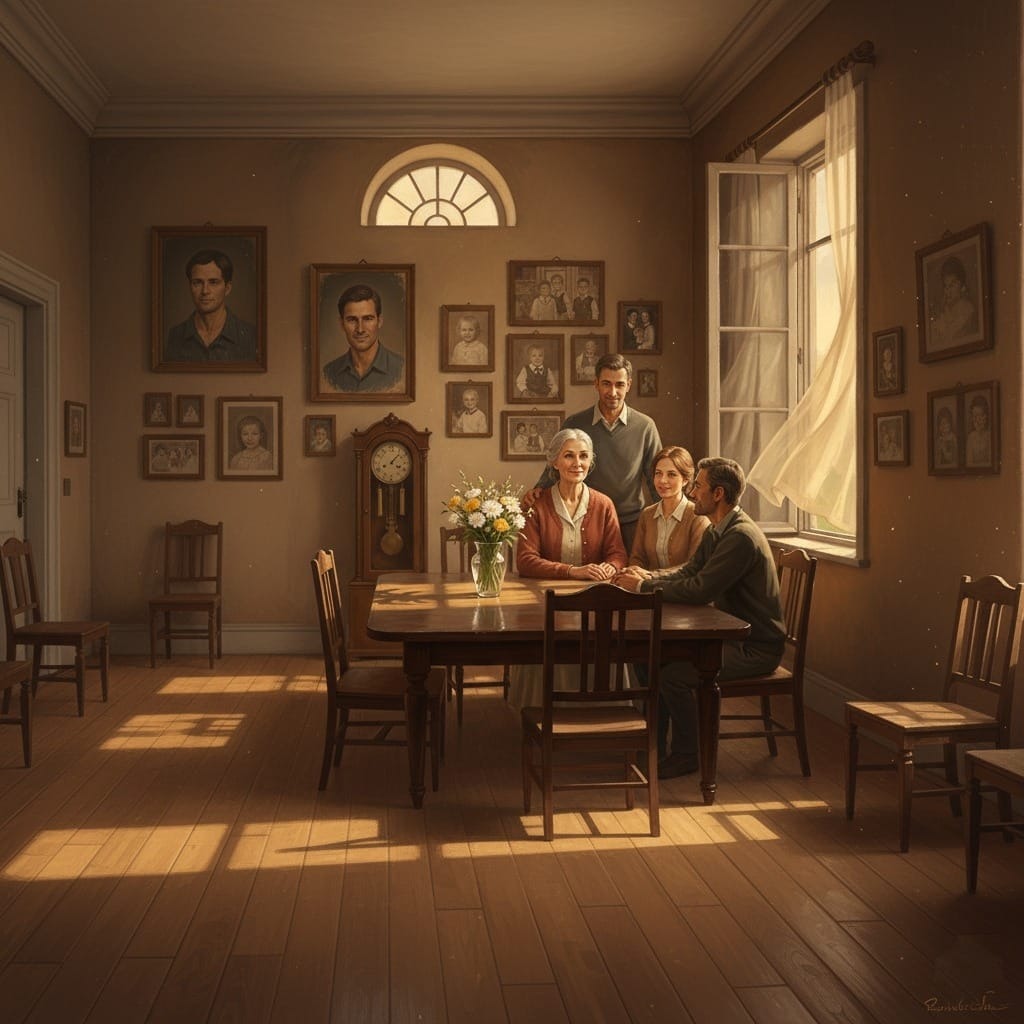
The years passed. The children grew, studied, fell in love, and built lives far from the walls that had once held them. When their father died, they came back, tall and kind and full of the world they had gone out to find.
At dinner, one of them finally asked the question that had always lived in their eyes.
"Why did you stay?"
She smiled, not sadly but with the quiet certainty of someone who had made peace with her choices long ago.
"Because you were still blooming," she said. "And I knew the wind would not raise you the way I could."
The silence that followed was not heavy. It was full. They understood, perhaps for the first time, the shape of what she had carried and the reason she had chosen to carry it.
Later, when the house had gone still, she sat by the window. The wind outside no longer unsettled her. She had faced stronger things.
She had no regrets. Not because the years had been easy, but because the children sitting at her table that evening were proof that the choice had been right. They were her answer, grown tall and whole and entirely themselves.
She had not stayed out of weakness. She had stayed out of a love so clear and so decided that it had never once wavered, even on the days when everything else did.