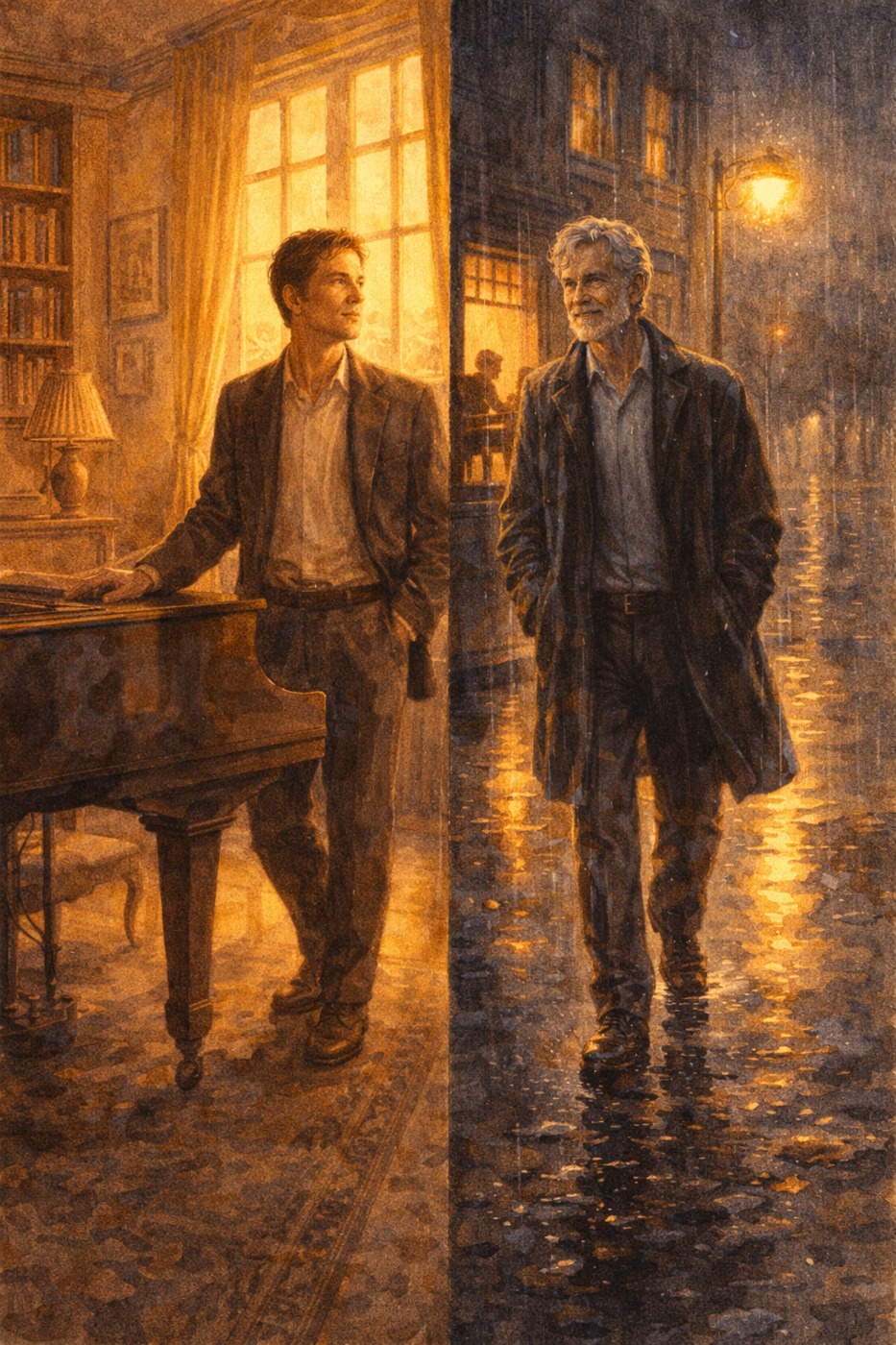
It never rains when you are ready for it. It simply comes, uninvited, and always at the wrong time.
He was born into comfort. A house with tall windows, summers by the sea, and the kind of certainty that made the world look safe and permanent. His parents gave him everything they could: piano lessons, horse riding, chess, languages, art. He grew up believing that effort led to reward, and that reward was something solid enough to hold.
When his father retired, he handed the company down as fathers do, with pride and with trust. It was not a small thing. It had employed dozens of people for two decades and carried the family name on its letterhead. He stepped into it believing he was ready. Then the markets turned, the economy shifted, and the company that had survived his father's generation did not survive his. It collapsed within three years, taking with it everything the family had built and everything he had assumed would always be there.
The debts came next, followed by letters, meetings, and the quiet shame of selling things that had meaning to people who would never know what they had once meant. He called it the storm, because once it started it did not stop. One loss pushed the next. One change pulled another behind it, like dominoes falling neatly, almost politely, as though life were proving a point it had always intended to make.
He should have stopped there. Taken stock, started small, accepted what had happened and built from the ground up. But pride is a difficult thing to put down when it is the last possession you have left.
He borrowed money from people he should not have borrowed from, convinced he could rebuild quickly, that the life he had known was only temporarily out of reach. He made investments based on confidence rather than knowledge. He spoke with the authority of a man who had once had reasons to be certain, long after those reasons had gone.
Within a year, the second collapse came. Smaller than the first in numbers, but far more damaging in every other way. Because this one was his. He could not blame the markets or the economy or the timing. He had walked back into the rain without a coat and been surprised to get wet.
That was the moment he broke.
Not loudly. He did not rage or make promises he could no longer keep. He simply sat in his small, rented room one evening and understood, with a clarity that felt almost physical, that the man he had been trying to remain no longer existed and was not coming back. There was nothing left to protect. No image, no status, no version of himself that required defending.
It was, strangely, a relief.
He found a small room to rent, the kind where silence sounds different at night. He learned how to cook, how to wait, how to count coins before buying bread. What had once felt like punishment began, slowly and without announcement, to feel like something else entirely.
What he had once called hobbies became his bridge. He started giving piano lessons to children in the neighbourhood. On weekends he taught horse riding at a stable outside town. Chess, which he had once played for leisure, became a way to earn a little extra, teaching patience to those who had none.
People said he adapted quickly. He knew the truth. He had been prepared for exactly this his whole life. He simply had not known it. Every lesson his parents had given him, every skill acquired in comfort, turned out to be training for survival in a way nobody had intended but life had quietly arranged.
Sometimes, walking home after a long day, shoes wet from the rain, he smiled. Not out of joy exactly, but out of something steadier than joy. Understanding.
Life had taken almost everything. And in doing so, had given him back himself.
He no longer feared the rain. It reminded him that nothing stays dry forever, and those certain things, courage, purpose, the knowledge of who you are when everything else is gone, only show themselves once the rain has reached them.