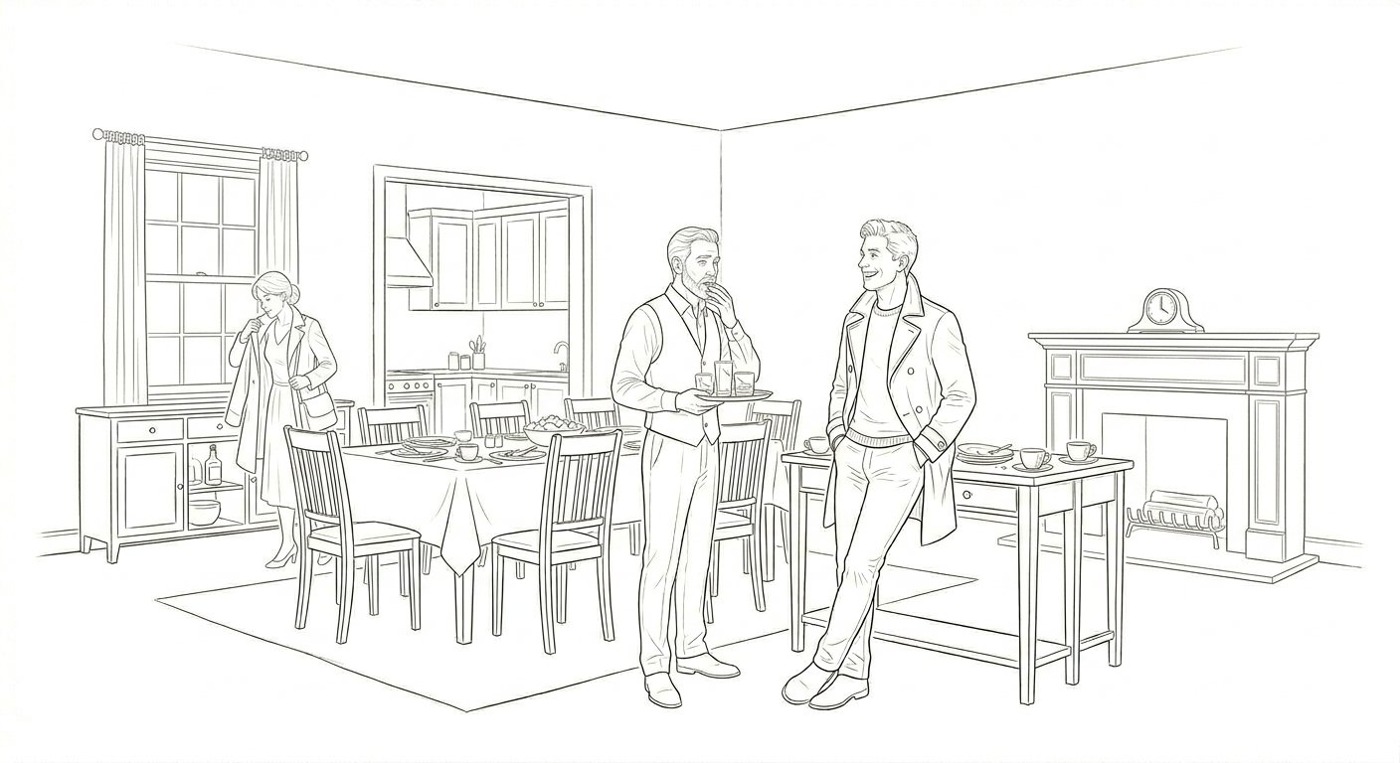
The evening has a shape.
Every host knows it even if they cannot describe it. There is the arrival, the early warmth of it, the food and the drinks and the conversation finding its level. There is the middle, the full hum of a gathering working the way it is supposed to work, everyone where they should be, the host moving through it all with the satisfaction of a thing going well. And then there is the end. It approaches gradually, in the way evenings always end: a slowness entering the conversation, a slight drop in energy, the first guest beginning to gather themselves to leave.
This is the moment the overstay begins to reveal itself.
The guest who stays too long does not always know they are doing it. Sometimes they are simply having an enjoyable time, and the signals are not reaching them. Sometimes they have nowhere urgent to be and the comfort of the evening has loosened their sense of time. Sometimes they are aware that the host is tired and the room is emptying and they have decided, for reasons known only to them, that this is not yet their problem.
The host who wants the evening to end faces a social bind. The conventions around ending a gathering are entirely indirect. The yawn that is not hidden. The mention of an early start. The clearing of glasses that have not been emptied. The lights in adjacent rooms going off one by one. These signals are legible to the guest who is paying attention. They are invisible to the guest who has decided not to.
What the host cannot easily do is say: the evening is over, please leave. Even when every part of them is saying exactly this, the social contract around hospitality prevents the words from forming. The host must continue to host, must continue to offer and engage and present the face of someone who is glad you are still here, while being very much not glad.
The overstay is not a crime. It is not the worst thing a guest can do. But it is a kind of thoughtlessness because it takes something that does not belong to the guest, which is the host's time and energy after the point when both should have been returned. The host gave the evening. The guest who stays past the end of it has started helping themselves to something that was never on offer.
The guest who stays too long has taken more than their share of the host's time. The guest in the next chapter takes a more direct approach to taking more than their share.