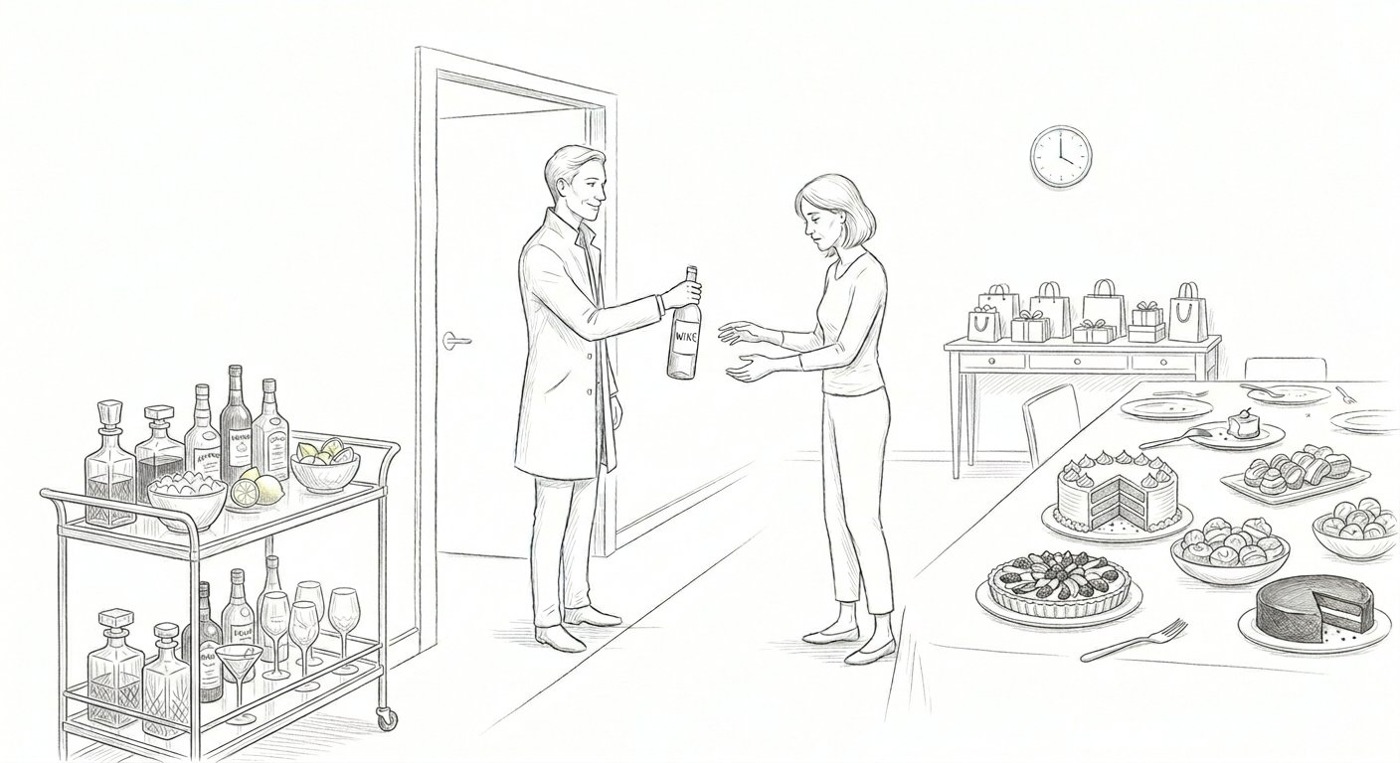
They do not break the rules.
This is what makes them so difficult to address. The loophole hunter moves through an evening with the careful precision of someone who has studied the terrain in advance and identified every gap in the fence. They do not do the things that are clearly not done. They do the things that are adjacent to those things, the things that fall just outside the boundary of what can be objected to, the things that are technically fine and practically not fine at all.
They were told the gathering started at seven, so they arrived at half past six, which is not early in any strict sense because the invitation said from seven, not at seven. They helped themselves to the food that was set out on the table, which was there to be eaten, and if they ate most of it before the other guests arrived, that is what happens when food is left accessible. They used the guest bathroom, which is what it is for, and if they spent thirty-five minutes in it during the middle of the dinner that is not something any rule explicitly forbids.
The loophole hunter is often charming. They have a gift for framing their behaviour in the most reasonable possible light, and the framing is usually technically accurate, which is precisely the problem. You cannot object to the thing they have done without objecting to a version of the thing that sounds entirely reasonable, and by the time you have finished objecting the conversation has moved on and they have found another gap.
What the loophole hunter does not understand, or understands and does not care about, is that the rules they are hunting through were never really rules. They were expressions of consideration. The reason you do not arrive ninety minutes early is not because a rule prohibits it. It is because the host is not ready and your presence at that point is a problem, not a gift. The reason you do not eat all the food before the other guests arrive is not because a contract forbids it. It is because there are other guests.
The loophole is always there. The host who leaves food accessible has technically made it available. The invitation that says from seven has technically opened the door early. The absence of an explicit rule is technically permission.
The guest who needs all of this to be written down has already told you something important about themselves.
The loophole hunter finds a way to take what they want while remaining technically innocent. The guest in the next chapter does not bother with loopholes. They simply look at what is in front of them and decide it is not good enough.