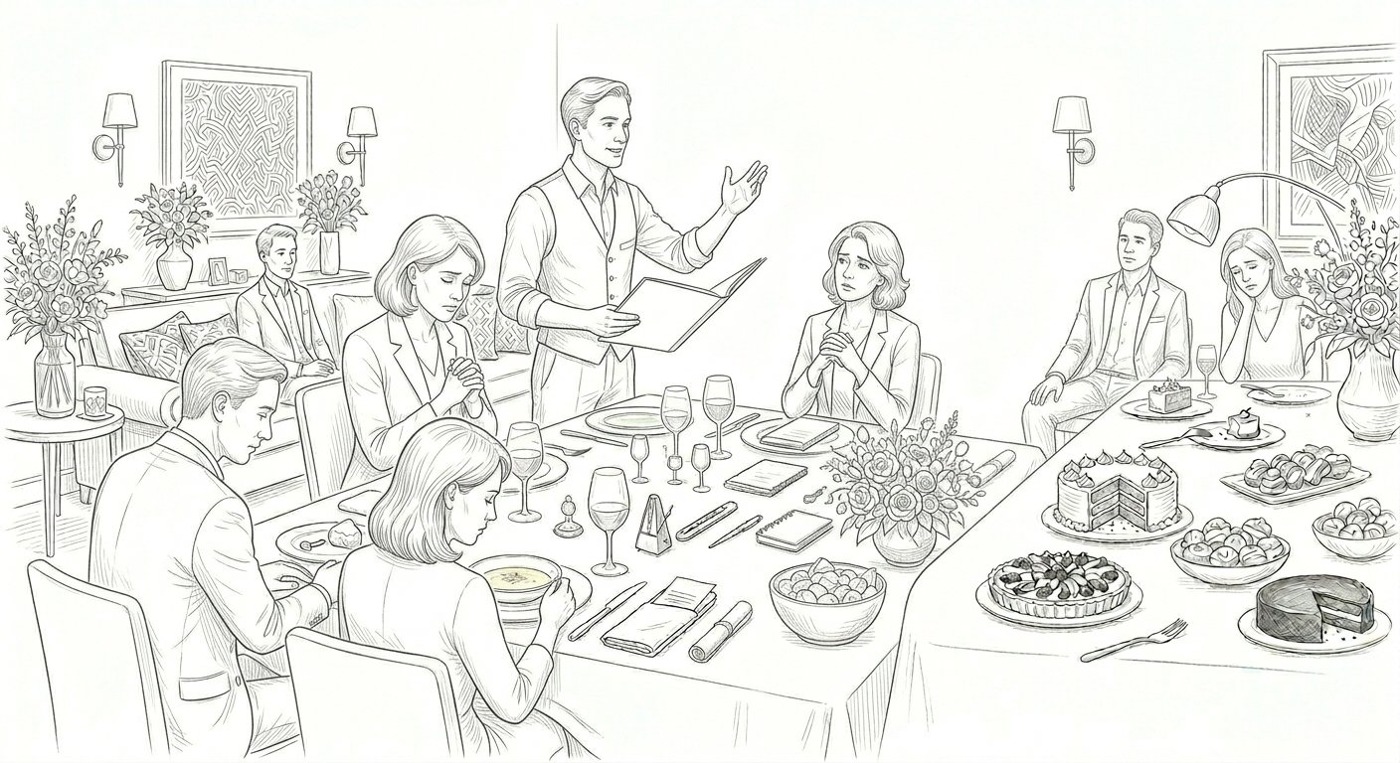
They planned it before they left the house.
That is the thing to understand about the speechmaker. The topic did not arise naturally from the conversation. It was not provoked by something that was said over dinner or triggered by a news story someone raised. The speechmaker arrived with an agenda, fully formed, and they have been waiting for the right moment to deliver it. The right moment is whenever the conversation pauses long enough for them to begin.
There are three kinds of speechmaker, and they are worth knowing separately.
The first is the monologue type. They hold the floor and they do not let go. What they are delivering is not a contribution to a conversation. It is a presentation. The subject can be anything: a political position, a dietary conviction, a strongly held view about how other people should be living their lives. The other guests find themselves in the audience of a talk they did not agree to attend, nodding at intervals, waiting for a pause that does not come. The host refills glasses. There is nothing else to do.
The second is the debate type. They have a position and they need a winner and they will not stop until they find one. The dinner table becomes a courtroom. Every response is treated as evidence. Agreements are acknowledged briefly and then moved past. Disagreements are the real material, the thing the debate type has been looking for, and they will work them thoroughly. The host has cleared the plates twice. The debate continues.
The third is the most patient and in some ways the most difficult. The brainwashing type does not raise their voice. They do not hold the floor by force. They simply keep returning to the same point from a different angle, quietly, persistently, with the manner of someone who has all the time in the world. They are not arguing. They are steering. The difference between the two is that arguments can be ended. Steering has no natural conclusion. The guest who eventually agrees just to end the conversation has not agreed at all, and the brainwashing type knows this, and counts it anyway.
Politics, religion, sports. These are the traditional territories of the speechmaker, and for good reason. Each of them carries the same heat, the same tribal loyalty, the same capacity to divide a room that was warm a few minutes ago into two camps that are not going to agree tonight. The sports fan who cannot read the room, who does not notice that half the table has gone quiet because they support the other side or no side at all, is running exactly the same operation as the political speechmaker. The topic is different. The mechanism is identical.
The host watches all of this and makes a private note. The note is not angry. It is simply accurate. This person arrived with an agenda. The evening was not the agenda. The evening was the venue.
Some guests arrive with opinions already loaded. Others arrive with something quieter and in some ways harder to manage. They arrive with a child.