There is a kind of arrival that requires no door.
The couple who came to work the farm, to run the workshop, to keep the house in order, they knocked. They negotiated. They understood the terms, spoken or not, and they accepted them. The accommodation was part of the arrangement, not a gift but a component, offered in exchange for something and valid for as long as that something continued. They knew this. It was clear at the start.
Their children did not knock. They were carried through the door before they could walk, and by the time they could walk the door had been open long enough that knocking did not occur to them. They grew up inside an arrangement they never agreed to and never needed to agree to, because the agreement had already been made by the people who brought them.
This is not their fault. A child does not choose the circumstances of their arrival. They inhabit what they are given, and what they were given was a space that felt entirely like home because they had known no other. The farm, the workshop, the accommodation that came with it, all of this was the landscape of their childhood. It was the only landscape they had.
The problem is not the children. The problem is the assumption that childhood familiarity with a space is the same as a claim on it.
The visitors who park in the host's space do so because they were told to park there by people who treated the space as theirs. The instructions were given in good faith. But the space was not theirs to give instructions about. The host comes home to find their own parking occupied by someone they have never met, and the explanation, when it comes, is offered with the mild surprise of people who did not realise this required explanation.
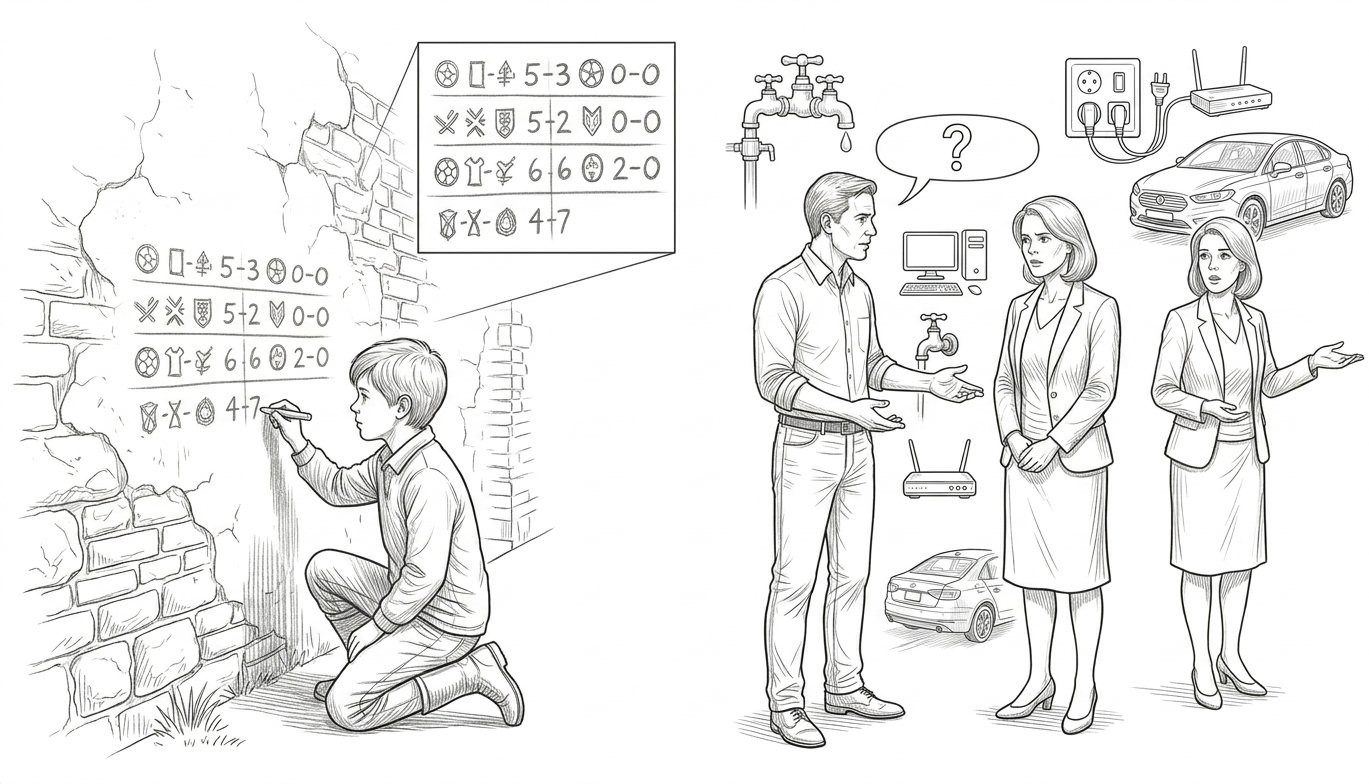
The children who play outside write on the walls with chalk. Football scores. Names. Dates. The wall is not theirs. Their parents did not own it and neither do they. But nobody told them this, because telling children not to write on walls requires a parent who understands whose wall it is, and that understanding had quietly faded somewhere between the first generation and the second.
The utilities allocated as part of the arrangement were reasonable for one couple doing the work they were hired to do. They were not designed for a household that had expanded without consultation. The water usage the host notices on the bill is not the usage of two working adults. It is the usage of an extended household that has, gradually and without announcement, taken up residence in a space that was sized and priced for something much smaller. The electricity bill tells its own story. The host reads it and understands, for the first time with full clarity, how far the arrangement has drifted from what was agreed.
The children who grew up alongside the host's children present a complexity. They played together. They went to the same places. They grew up with the same reference points and the same memories of the same summers. The host's children did not treat them as lesser, and the children of the guests did not see themselves as such. This was, in many ways, beautiful. In one way it created a problem.
Because equality of experience is not the same as equality of entitlement. The host's children grew up in a home that belonged to their family. The guest's children grew up in an allocation that belonged to an arrangement. Both sets of children felt equally at home. Only one set of them was.
The guest's children, now grown, speak about the place with the easy ownership of people who have always been there. They refer to the garden as the garden. The parking as the parking. The space as the space. They have never thought to add a qualifier, because qualifiers were never part of their experience. Nobody sat them down and explained the difference between growing up somewhere and owning somewhere, between being included in a life and having a claim on it.
The graffiti on the outside wall is the clearest illustration. The host's child who takes chalk or paint to their own family's wall is doing something that belongs to them. It is their wall, their home, their history being written on it. The guest's child who does the same thing has written on something that was never theirs to write on. The gesture looks identical. The meaning is not.
The arrangement that brought the first generation here was conditional and clear. The welcome extended to those who came with them, or after them, without negotiation, without contract, and without knocking, is a different thing. It was never offered. It was assumed. And the space between an offer and an assumption is where most of the difficulty in these pages has lived.
Some guests leave quietly. Others leave a mark. And some leave something neither the host nor the guest can quite name: a change in the room itself, gradual and lasting, that neither of them planned and both of them feel.