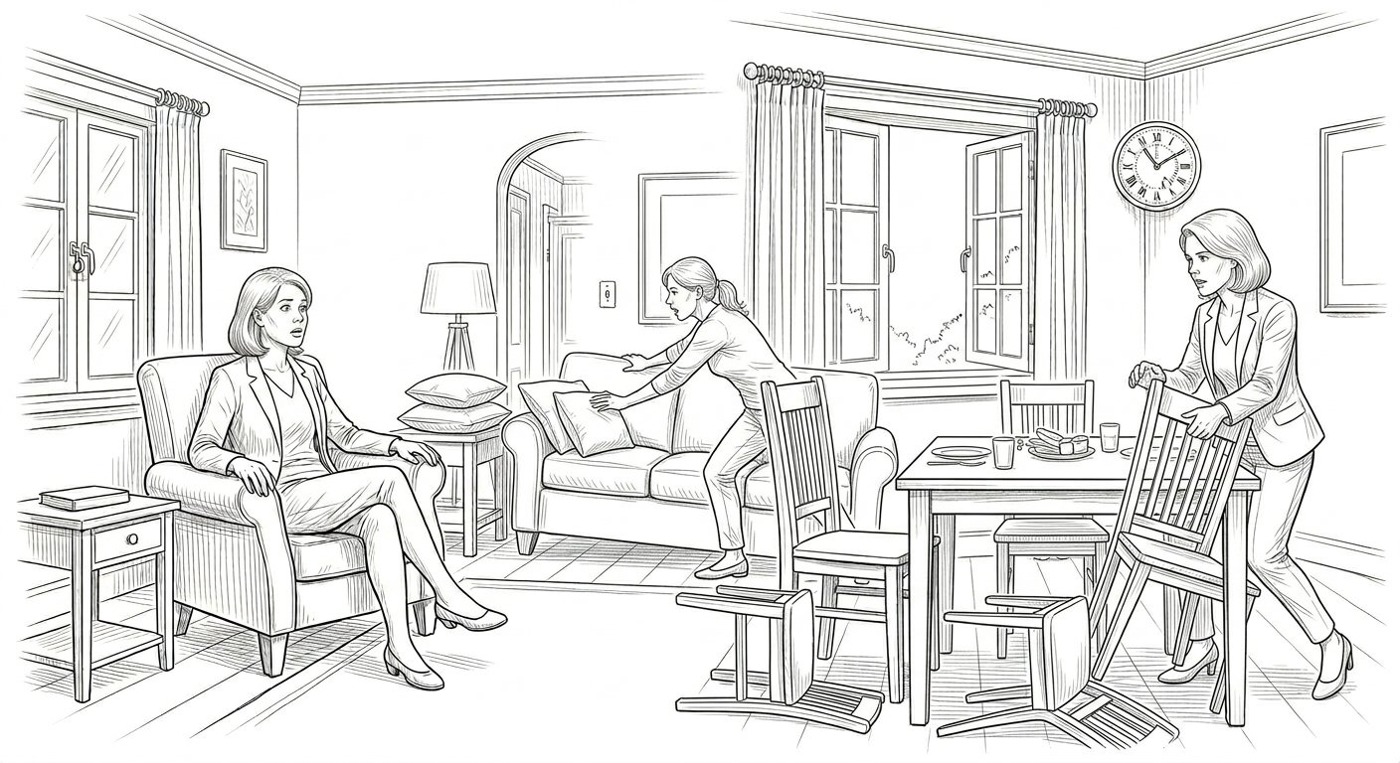
Nobody planned it.
That is the first thing to understand. Nobody sat down and decided that the house was going to be different now. Nobody announced a new arrangement. Nobody rewrote the rules, because rules were never the medium through which the change arrived. It came through something softer. Through small adjustments, tiny accommodations, individual moments of hospitality that seemed entirely reasonable at the time and only reveal their shape when you stand far enough back to see all of them at once.
The guest who changed the house did not arrive with a renovation in mind.
They arrived as a guest. They were welcomed, as guests are. They were made comfortable, as guests are. And then, gradually, the comfort they were given began to reshape the space around it. Not the walls. Not the furniture. The atmosphere. The unspoken understanding of what this place was and how it worked and whose preferences it had been built around.
It starts with something small. A request, reasonable enough, to adjust something. The music is a little loud. The window is open and there is a draught. The food contains something they would rather avoid. Each of these things is minor. Each of them is accommodated. The host is generous. The host is attentive. The host wants the guest to be comfortable, because that is what good hosts want.
But accommodation is a practice. And practices, repeated often enough, become policies.
The host who adjusted the music once finds themselves considering the music before the guest has said anything. By the third visit, they have a playlist. The window that was closed for the draught stays closed now, by habit, in that room, on that side of the house. The food that was avoided becomes food that is no longer served. Not because anyone asked. Because it was easier. None of these changes were lasting. Each of them was temporary. And yet here they are.
What the host has done, in a hundred small and generous acts, is moved the centre of the house from where it was to somewhere slightly different. The house still looks the same from the outside. The rooms are in the same places. The same people live there. But if you had been in the house before the guest arrived, and came back now, you would notice something you could not quite name. A difference in how the air sits. In whom the space has been arranged around. In whose comfort has become the quiet priority.
The guest did not notice this either. This is important. They were not engineering anything. They were simply present, and presence, sustained long enough, leaves marks. They brought their preferences and their habits and their way of occupying space, as everyone does, and the house absorbed them the way houses absorb everything. Slowly, without ceremony, and completely.
The host, who is generous and accommodating and slow to complain, did not notice the accumulation. They only noticed the total. One morning, or one evening, or at some unremarkable moment in the middle of an ordinary day, they looked around the room and could not quite locate themselves in it. Everything was familiar. Nothing was exactly right. The space felt like a room they had lived in for a long time but had not, somehow, chosen.
The music playing was not theirs. The window was shut. The thing they used to cook on Sundays had quietly disappeared from the menu without anyone calling a meeting about it.
That is the guest who changed the house. Not the one who broke things. Not the one who stole or demanded or overstayed in any way that could be named and addressed. The one whose presence, offered and received in perfect good faith, quietly moved everything two inches to the left. Enough that nothing is wrong. Enough that the host cannot explain what is different. Enough that the room is no longer entirely theirs.
The house is the same house. The guest is a good guest. The host is a good host.
Something was lost anyway.
Every guest leaves something behind. Some leave gratitude, some leave mess, some leave the warmth of an evening that will not come again. Some leave a mark on the room itself, so faint it cannot be pointed to, so real it cannot be denied. The guest who leaves the biggest mark is not always the one who stayed the longest. Sometimes it is the one who simply arrived with the most certainty about how a room should feel.