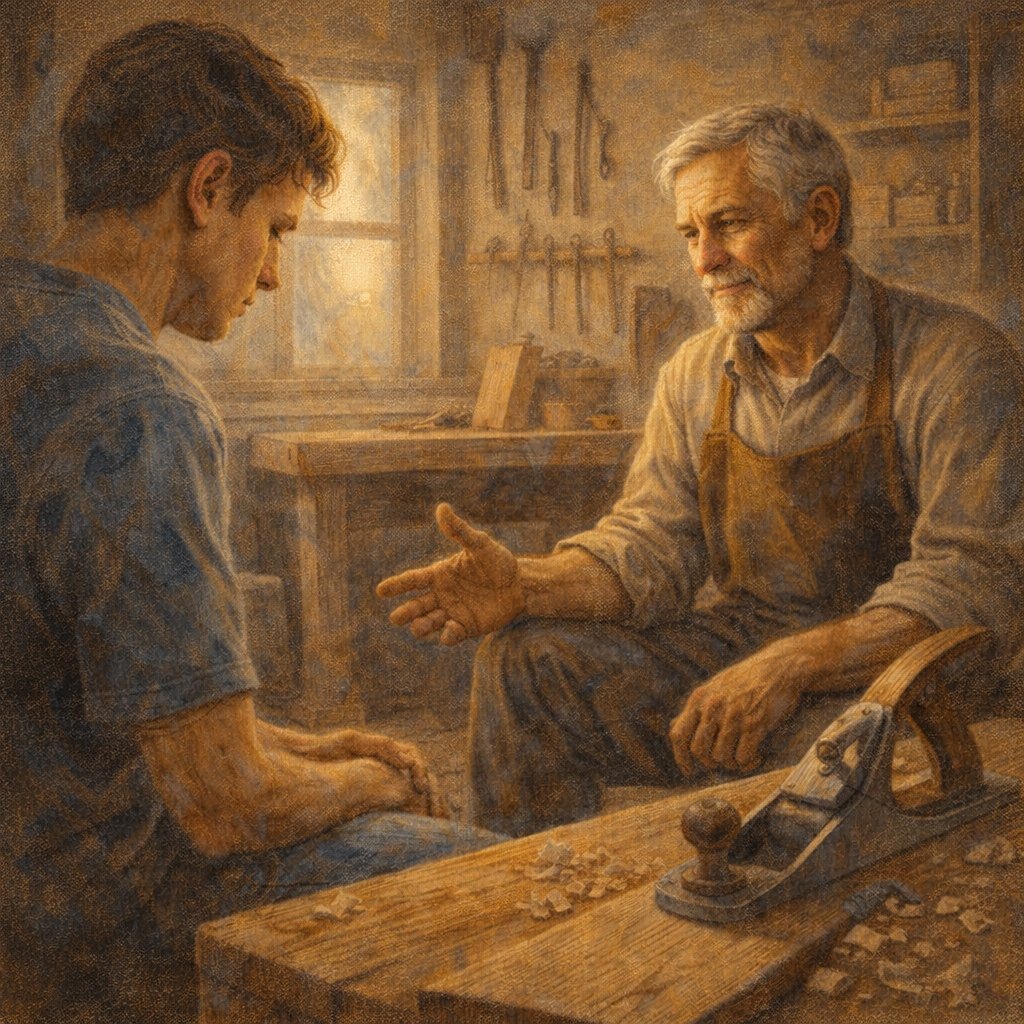
He had spent his life among wood and nails.
Shaping beams, carving frames, turning raw timber into things that would outlast him. Every cut mattered. Every joint had to fit without force. Every surface needed the patience of sanding and smoothing until it was ready to endure. The carpenter loved his craft not because it gave him a living, but because it gave him pride. Each piece that left his workshop carried his name, even when no one knew it.
When he hired a young trainee, he treated him as a son. He taught him the small secrets that only years of practice reveal, how to listen to the saw to know if it was cutting true, how to measure twice with the ruler and the eyes, how to feel the grain beneath the fingers and follow it rather than fight it. The young man learned quickly, and in time earned the right to take on small jobs alone.
At first, the carpenter was proud. Then the complaints began to arrive.
Hinges came loose. Doors refused to close. Tables wobbled after only a few weeks. He went himself to fix each mistake, without charging a coin. But each visit cost him something that money could not measure. A reputation is built slowly, like two beams joined with care. It can split in an instant if neglected.
He called the young man to sit with him. He did not shout. He asked quietly. "Why are my clients no longer smiling? Why is my name being questioned?"
The young man looked down, ashamed but honest. "I just cut corners to save time. I didn't mean any harm."
The carpenter's voice was heavy, not with anger but with pain. "My reputation is my dignity. Every plank, every nail, carries my name long after I am gone. When you rushed the work, you were not only ruining what you built. You were wounding me."
The silence that followed lasted longer than any lecture.
"We must part ways," the carpenter said quietly. "Work is not a race. It is a mission, a passion, and a promise. If time is all you care about, then this craft was never truly yours."
The young man left without argument. He had none to give.
The carpenter returned to his bench, picked up the tools that had never betrayed him, and began again, slower, steadier, the way he always had. For he understood that in every honest cut lay not just the work, but the man himself.