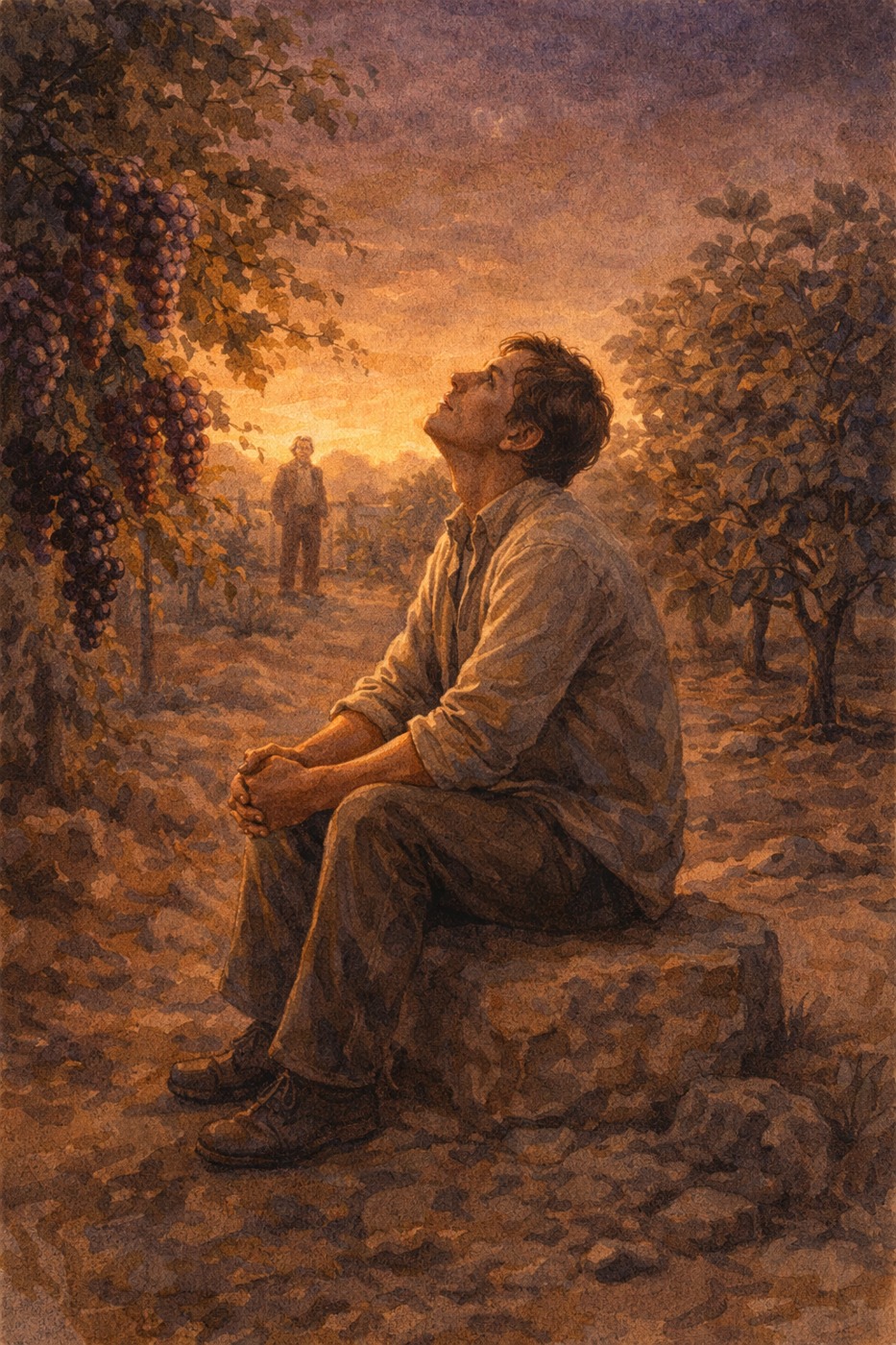
The village was small, cradled between rolling hills and endless orchards of grapes, figs, and apples. Life there was quiet, but not easy. Among its modest cottages lived a man who struggled each day to bring food to his family's table. Work had vanished along with the younger generation who had left for the city, and what remained was silence and hunger in equal measure.
That evening, he walked home empty-handed again. His steps grew slower the closer he came to his door. He dreaded the sight of his children waiting outside, their faces lit by the hope that tonight might be different.
Exhausted, he stopped to rest on a large rock that sat between two vast orchards. The air was sweet with ripe fruit. It was harvest time. Grapes hung like dark jewels in the fading light. Figs glistened on the branches, soft and ready to fall at the slightest touch.
Two voices stirred inside him.
The first was quiet and urgent. Take some. No one is watching. Your children are hungry.
The second was firmer and older. Do not. These fruits are not yours. They belong to another man's labour.
The voices fought inside him. He buried his face in his hands, caught between need and something he could not bring himself to set aside.
He did not hear the footsteps approaching.
"What are you doing by my orchard?"
The voice was sharp and suspicious. An old man stood at the gate, a walking stick in his hand, his eyes narrow and watchful. He was the owner, that much was clear, and he had seen enough of the world to know that a hungry man sitting beside ripe fruit at dusk was not simply resting.
The poor man stood quickly. "I stopped to rest, sir. Nothing more."
"Rest," the old man repeated, the word carrying more doubt than any accusation. He looked at the man carefully, then at the orchard behind him, then back again. "I have lost more fruit to resting men than to any storm."
"I did not touch anything," the poor man said quietly. "Not one grape."
"Not yet," said the old man.
The silence between them was uncomfortable and long. The poor man felt the weight of it, the unfairness of being suspected for a crime he had chosen not to commit. He could have walked away without a word.
But something in him refused to leave without being believed.
"I will tell you the truth," he said. "I thought about it.
I will not pretend otherwise. My children are waiting at home, and their faces will fall again tonight when I arrive with nothing. The fruit was right there, and no one was watching." He paused. "But I did not take it. Not because I was afraid of being caught.
Because it is not mine. Because my mother raised me to know the difference between what I need and what I have earned. And I have not earned this."
The old man was quiet for a long moment, his expression unreadable.
Then something in his face shifted.
He looked at the orchard around him, at the heavy branches, the fruit that needed picking before it fell and was wasted. He looked at his own hands, thin and stiff with age. He thought of the young men who had left, one by one, until the harvest had become something he could barely manage alone.
"How long have you been without work?" he asked, his voice different now.
"Long enough," the poor man said simply.
The old man opened the gate and stood aside. "Come in," he said.
The poor man hesitated.
"I am not offering you charity," the old man said firmly, as though he had read the hesitation correctly. "I am offering you work. My hands are old and the young ones have all gone to the city.
This harvest will rot on the branch if I cannot find someone willing to earn it honestly." He looked at him steadily. "You said you know the difference between what you need and what you have earned. Come and earn it then."
The poor man stepped through the gate.
They worked side by side until the last of the light was gone, the old man directing and the young man filling basket after basket with quiet efficiency. When they finally stopped, the old man filled a large cloth with grapes, figs, and apples and pressed it into the poor man's hands.
"Tomorrow," he said. "And the day after. For as long as the harvest needs you."
The poor man looked at what he was holding. His children's faces rose in his mind, the hunger in them, the hope. His eyes filled.
"Why did you believe me?" he asked. "You did not have to."
The old man smiled for the first time that evening. "I did not believe you immediately," he said honestly. "But I have lived long enough to know that a man who admits to a temptation he resisted is worth more than a man who claims he never felt it. Anyone can be honest when it costs them nothing. You were honest when it cost you everything."
That night, his children waited by the cottage door as they always did.
But this time, their father came home smiling, his arms full and his heart fuller.
And all the way back along Orchard Road, he thought not of the fruit or the coins that would follow, but of what he would tell his children when they asked where it all came from.
He would tell them the truth, every word of it, because that was the only story worth passing on.
His mother had fed him on principles before she ever fed him on bread.
Now it was his turn.