Everyone in town knew her.
Not because she was famous, rich, or talented, but because she knew everything about everyone. Or at least that was what she claimed.
Her stories travelled faster than the morning paper. A neighbour's argument became a scandal. A friend's difficult week became a broken marriage. A passing comment became the headline at her Thursday coffee gatherings. She never called it lying. She simply added a little flavour, she said, as though words were a recipe, and she was merely improving the taste.
At the book club she was the star. Not because she read the books, but because she always arrived with a new story. Her friends laughed, leaned in, and sometimes asked for more, and she loved that. She never thought of it as harm. It was entertainment, small talk, the kind of chatter that fills a room and makes an afternoon pass quickly.
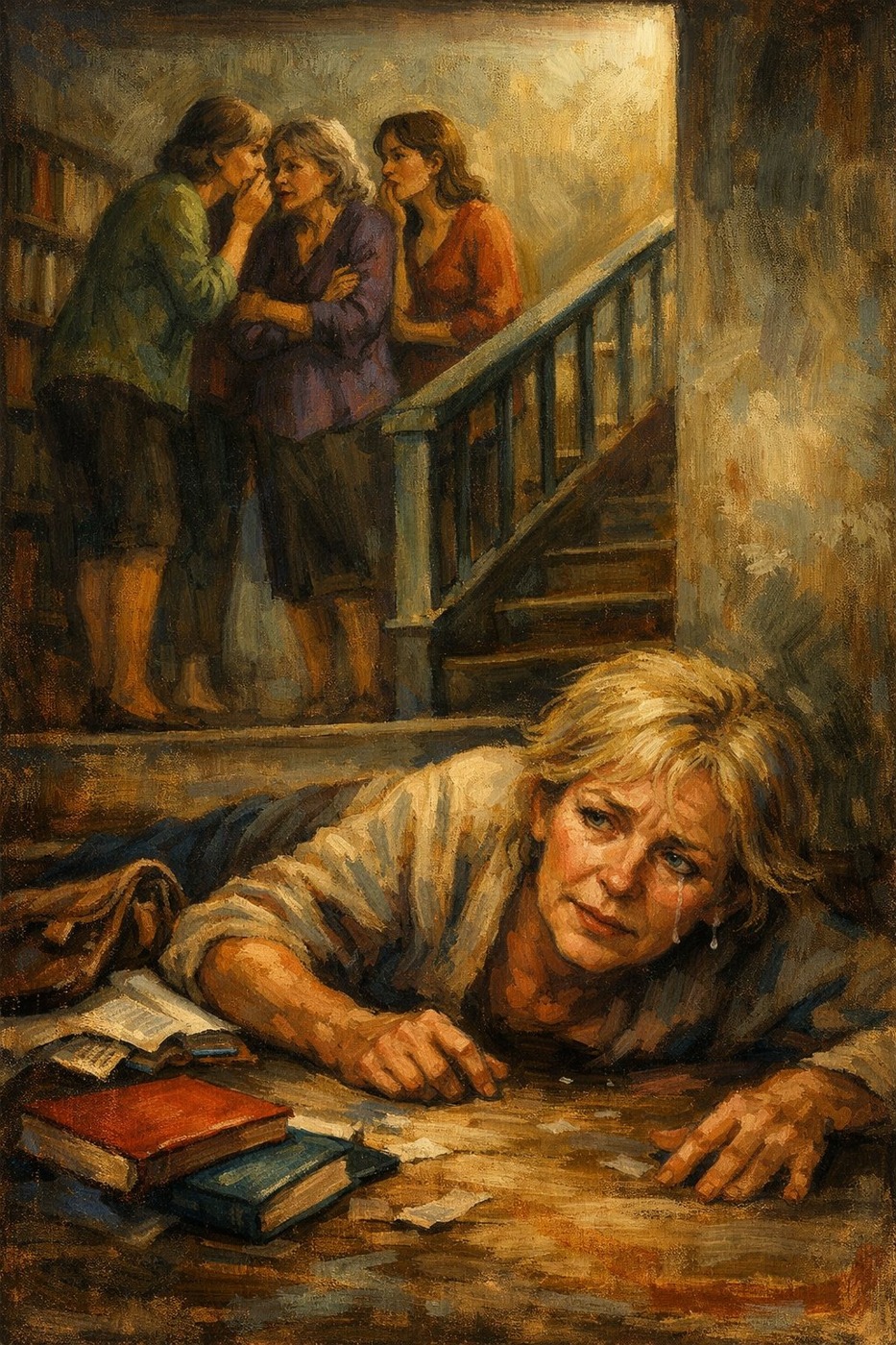
One Thursday she arrived at the library early. The group met in a quiet room downstairs. She was halfway down the staircase when her heel caught the edge of a step. Her bag flew from her hand, books scattered across the floor, and she fell.
She did not open her eyes. She was not sure she could. Her body felt heavy and unresponsive, the world reduced to the cold of the floor beneath her and the voices gathering above. But her ears worked perfectly.
The women gathered around her, whispering first in concern, and then, as concern settled into something more comfortable, in truth.
"She talks too much," one said softly.
"She hurt my sister with her gossip," another added.
"I like her," someone else whispered, "but I could never trust her."
She heard every word. Each one cut deeper than the fall itself. Her mouth wanted to speak, to defend herself, to explain, but nothing came. She lay still while their voices moved around her like something she could not escape and had not been meant to hear.
In that silence, the faces came to her. Friends she had spoken about freely. Neighbours whose private struggles had become her stories. Her own family, whose small moments she had carried to other tables without a second thought. She remembered the pleasure of being the first to tell, the warmth of people leaning in to listen. And now, lying on that cold floor, she understood for the first time what it felt like to be on the other side.
It felt ugly. Lonely. Exposed.
When her body finally allowed her to move again, she wept. Not from the pain of the fall, but from something older and harder to name. She made herself a promise in that quiet room: no one's name would leave her lips again without something kind attached to it.
The book club was different after that. Her words grew shorter, slower, more considered. Some of the women never noticed the change. Others did. And those who had quietly drifted away from her company began, gradually, to sit beside her again.
They say people who live in glass houses should not throw stones.
She had always known the saying. She had simply never understood, until that afternoon on the library stairs, that she had been living in one all along.