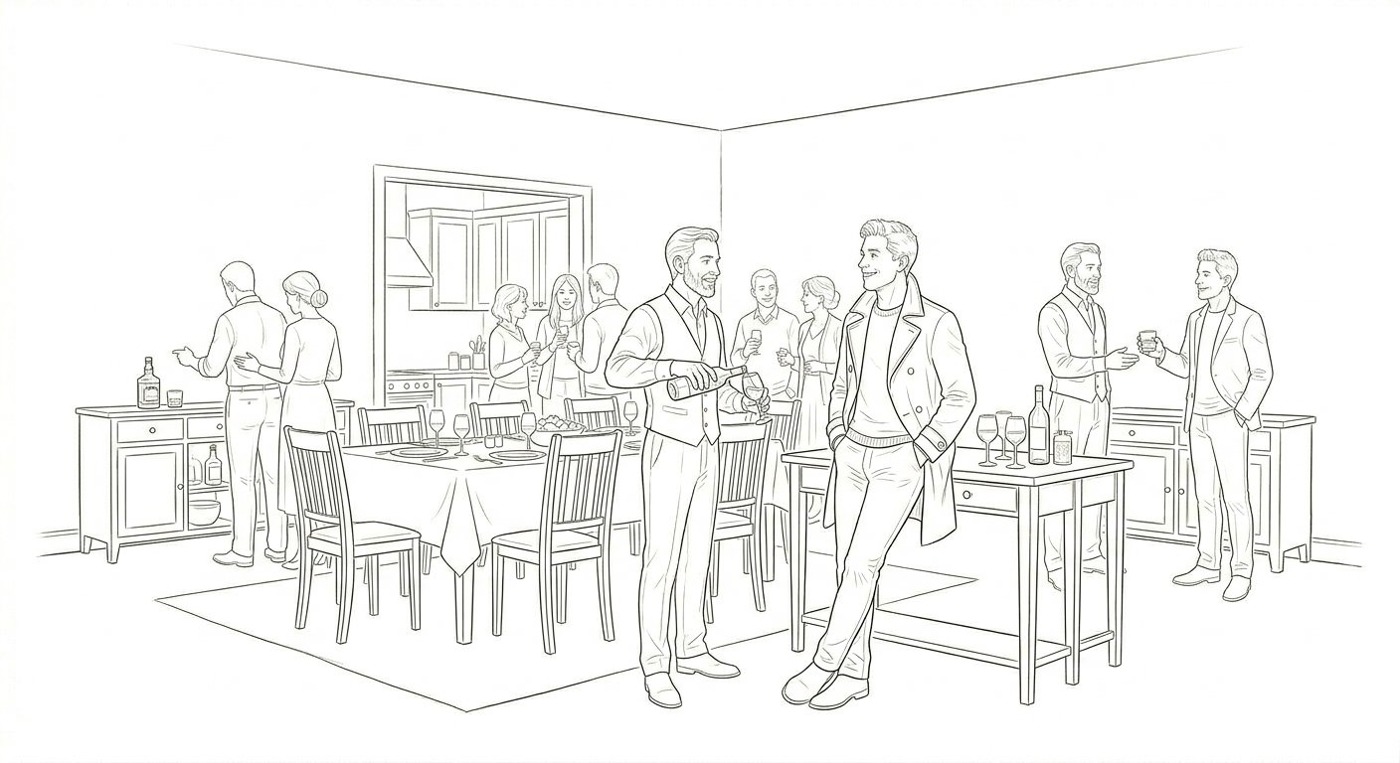
The host says it with warmth and they mean it well.
Make yourself at home.
It is an expression of generosity, an invitation to relax, a signal that the formalities can be set aside and that the guest is welcome to be comfortable in this space. It is not a transfer of ownership. It is not a key to every room, a licence for every drawer, an authorisation to treat the host's home as an extension of the guest's own. But some guests hear it that way.
The guest who makes themselves too much at home usually begins in the kitchen. They do not wait to be offered a drink. They find the glasses, locate the good bottles, and help themselves with the confidence of someone who lives there. This is charming in a close friend of twenty years. It is disconcerting in someone who has visited twice. The host watches it happen and recalibrates every assumption they had about the evening.
Then there is the fridge. The guest who opens the host's fridge without being invited into it has crossed a line that most people do not need to be told exists. A fridge is not a public resource. It contains the contents of a private life: the half-used jar of something, the leftovers from two nights ago, the things that were not offered because they were not part of the evening. The guest who opens it and helps themselves to something has not simply taken a piece of food. They have walked through a door that was not open to them.
The bedroom door is another matter entirely. There is no version of making yourself at home that includes wandering into the host's bedroom without invitation. None. And yet it happens, usually framed as curiosity or the need for a quieter space or the looking for something that could have been asked for. The host who finds a guest in their bedroom has had their home reduced to something smaller. A space they now share without choosing to.
The remote control is a smaller version of the same principle. The guest who picks it up without asking has made a decision on behalf of everyone in the room about what the evening sounds like or looks like. The guest who opens drawers is looking for something that was not offered. The guest who helps themselves to whatever has been left out has mistaken the host's generosity for a standing arrangement.
Make yourself at home is an expression of warmth. The guest who treats it as a literal instruction has misread both the expression and the warmth behind it. The host's home is the host's home. The guest is in it by invitation. These two facts do not change because the host was kind enough to say something welcoming at the door.
The guest who has made themselves too much at home often has difficulty leaving. They have settled. They have nested. The signals that the evening is ending do not reach them in the same way they reach everyone else. That guest has a chapter of their own.