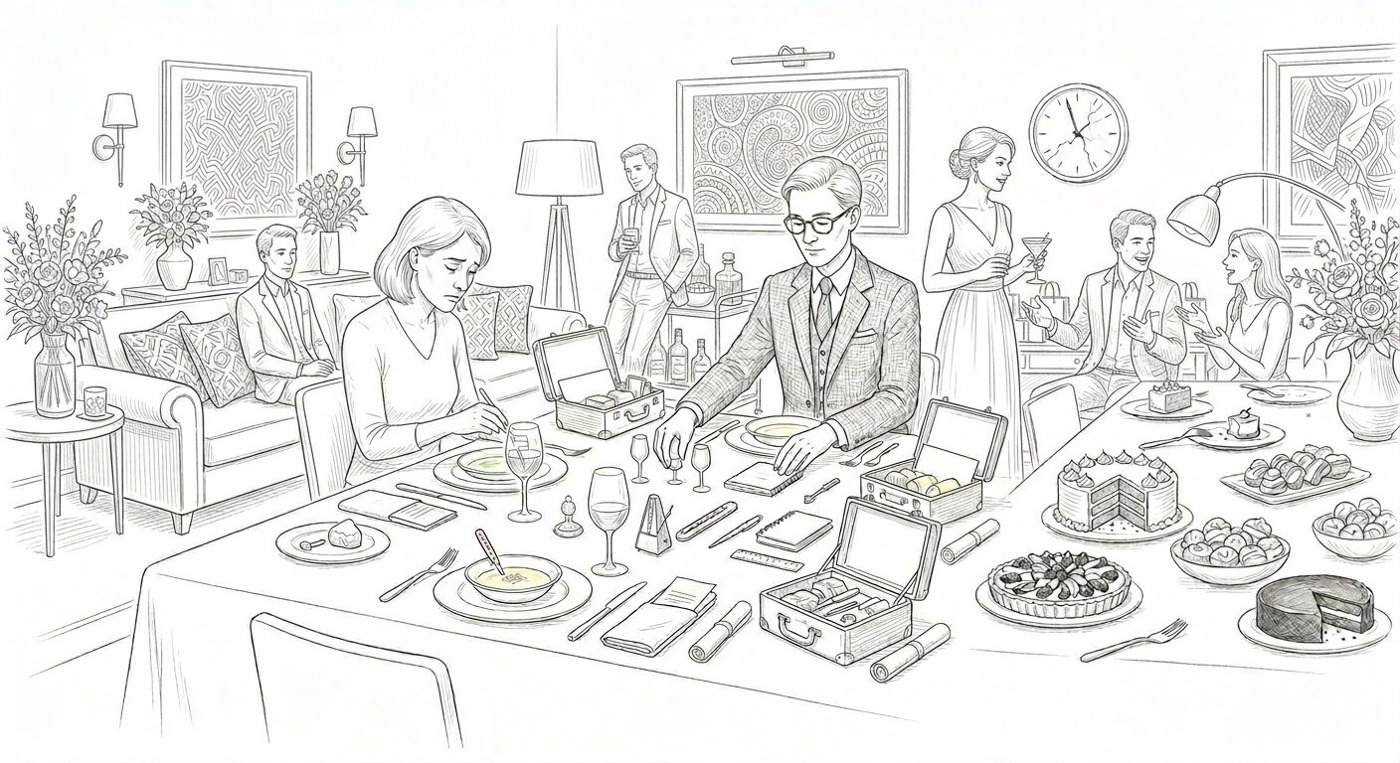
The critic arrives with standards.
Not explicitly. They do not announce at the door that they will be assessing the evening. They do not produce a notebook or a scoring sheet. They arrive as a guest, they are welcomed as a guest, and they move through the occasion in the way guests move through occasions, eating and drinking and participating in conversations. But underneath all of this, quietly and continuously, they are judging.
The host senses it early. There is something in the way the critic looks at the food before they taste it. Something in the pause before they say how lovely when told what they are eating. Something in the way they look at the room when they first walk in, a survey rather than an appreciation. The host cannot point to it exactly, but it is there, and it changes the quality of the evening in a way that is difficult to explain to someone who has not felt it.
The criticism is not always delivered out loud. Sometimes it stays internal and leaks only through expression and timing. But often it finds its way into words, framed carefully as observation rather than verdict. The journey was difficult, which is a comment about the location. The room is very warm, which is a comment about the host's management of their own home. I usually prefer mine with a little less, which is a comment about the food. Each of these is technically a neutral remark. Accumulated over the course of an evening, they form a case.
The critic does not mean harm. This is important to understand. They have standards and they apply them consistently and they believe, with genuine conviction, that the application of standards is a form of care. They notice things other people miss. They offer assessments that are, in their own framing, a gift. The host should know about the journey. The room temperature is relevant information. The food could be improved.
What the critic does not notice is the cost of all this noticing. The host who has prepared an evening and is then assessed throughout it is not receiving a gift. They are receiving a verdict on something they worked to create, delivered by someone who was invited to enjoy it rather than evaluate it. The distinction matters.
The dinner table is not a review platform. The host's home is not a venue submitting for consideration. The evening was made for the people in it, and the people in it have one job, which is to be present in it with some basic gratitude for the fact that it exists.
The critic goes home and writes the review in their head. Sometimes it finds its way into the world. The host washes up and feels, without knowing quite why, that the evening was slightly less than it should have been.
Some guests find fault with everything the host provides. Others arrive having already decided that what the host provides is theirs to redirect. They do not criticise the evening. They take it over.