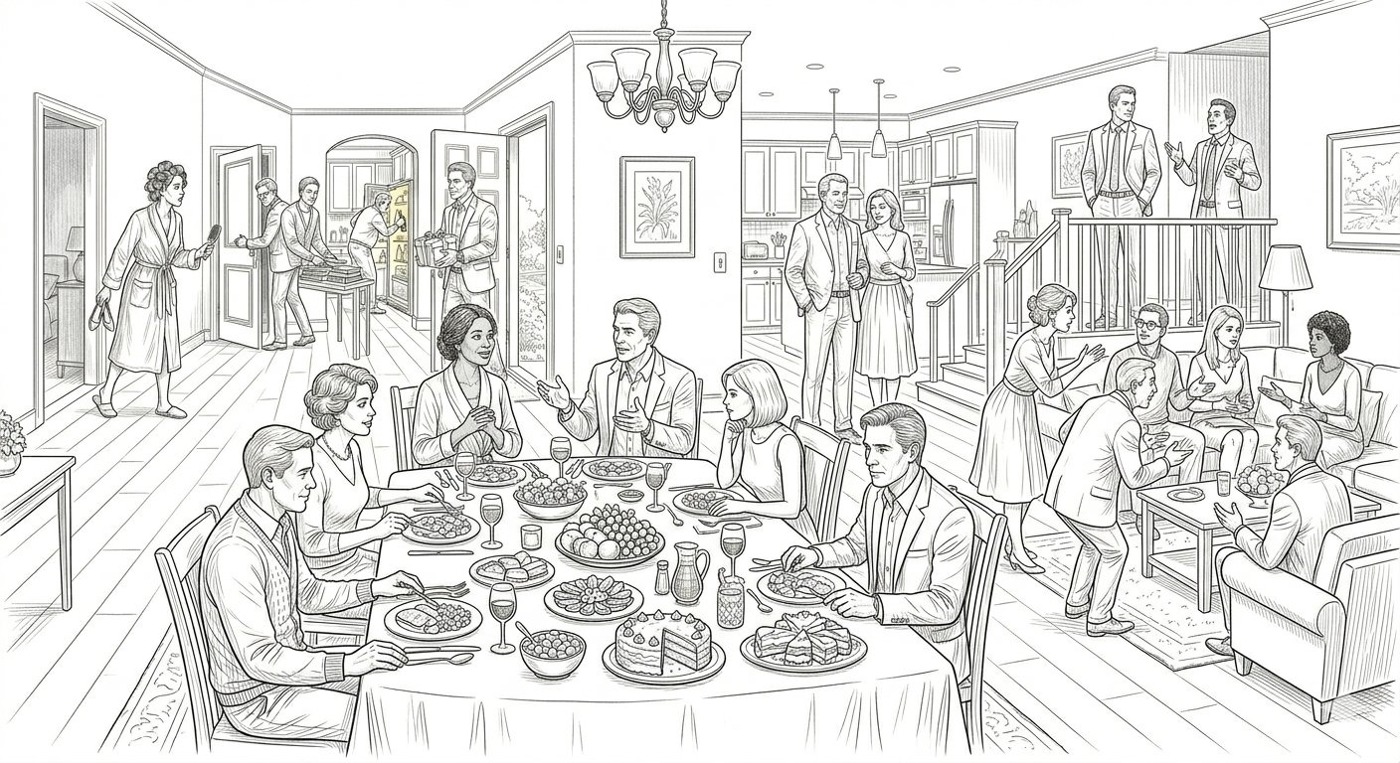
Look around any room at a gathering and you will find the same people.
Different faces, different names, different cities, but the same people. They have always been there. They will always be there. The gathering is simply where they become visible.
The Invisible sits in the corner and stays there. Not because they are shy, necessarily, though sometimes that is part of it. They have simply decided, at some point before they arrived, that the evening is not really for them. They accept the food when it comes. They respond when spoken to. But they initiate nothing and volunteer nothing and at the end of the evening they leave without anyone being quite sure when it happened. The host counts back through the evening and cannot locate the Invisible in any moment. They were there. They simply occupied the space without contributing anything to it or taking anything from it. A presence that left no trace.
The Opinion Nobody Asked For has a diagnosis for every situation and a solution for every problem that nobody presented as a problem. They listen to someone describe something and their face arranges itself into the expression of someone receiving a briefing. By the time the story ends, they are ready. Their contribution is rarely comfort or curiosity. It is assessment. You should have done it differently. The way I handle that kind of thing is. What you need to understand is. The person who was speaking is not sure when they stopped having a conversation and started receiving a consultation.
The Grateful is a different creature entirely. They received the invitation and felt the weight of it. They arrived already warm. They say thank you and they mean it, not as a formality but as an actual expression of something they feel. They notice the effort and they say so, not with excessive praise but with genuine acknowledgement. They are the guest who makes the host glad they opened the door. They do not need to be managed or monitored or accommodated beyond the normal scope of a gathering. They have brought the one thing that cannot be bought or prepared in advance, which is the simple recognition that they are somewhere that someone worked to create for them.
The Gossiper arrives already in motion. They have things to tell you and the telling cannot wait. Every guest at the gathering is a potential audience and every piece of information they carry is a currency that depreciates with time. They move through the room efficiently, depositing what they know, collecting what others know, and synthesising the whole into a narrative that will leave the gathering and travel to places the subjects of it would not choose. The host knows this guest. The host has seen the information travel before. The host is careful about what they say in the Gossiper's presence without ever having decided to be careful. It happened gradually, the way all forms of self-protection happen.
The Conspiracy Theorist has a framework, and the evening is an opportunity to apply it. Whatever is being discussed, the framework accommodates it. News, medicine, finance, the behaviour of governments, the motivations of organisations, all of it fits. The framework is comprehensive and internally consistent, and it does not require evidence because the absence of evidence is itself part of the framework. Other guests find themselves in a familiar position: they can engage, which leads somewhere long and circular, or they can change the subject, which the Conspiracy Theorist will circle back from. The evening absorbs this as evenings absorb most things, which is to say imperfectly.
The Envious is harder to see. They are not unkind. They participate normally. But there is a quality to their engagement with good news that is slightly off. A congratulation that lands a moment late. A compliment that has a small qualification attached. A question about someone's success that is phrased as curiosity but carries something else underneath it. The Envious has not chosen this. It is not a performance. It is a leak, something that escapes despite them, and most of the time they are the last person in the room to notice it.
The Attention Seeker comes in two versions. The loud version performs. A story that grows with each telling. A laugh that arrives slightly before anything funny has happened. A crisis, not large enough to be serious but large enough to require everyone's focus for a while. The quiet version simply ensures, through small and consistent manoeuvres, that the room's eye never strays from them for too long. The host finds themselves, by the end of the evening, slightly depleted in a way they cannot entirely explain.
The Partner Hunter is at the gathering for reasons that run alongside the stated ones. They accepted the invitation and they are here, fully present, engaged and charming and asking excellent questions. But they are also scanning. Not obviously. They have done this before, and they have learned that obvious does not work. They are assessing the room with one part of their attention while giving the rest of it, generously, to whoever they are speaking to. If the evening yields nothing, they will leave graciously and try the next one. If it yields something, the host will find out about it later, usually in a message that begins with a slightly sheepish thank you for the introduction, even though no introduction was made.
The Arrogant accepted the invitation after consideration. This is something they want you to understand, not because they will say it directly, but because everything about their presence communicates it. The way they look at the room when they enter. The way they respond to introductions, warmly enough but with a calibration that tells you where they have placed each person in a hierarchy they assembled on the way over. They are not rude. Rudeness would require them to care enough to be hostile. They are simply somewhere above the gathering, looking down at it from a height they consider earned, and they will return to their real life afterwards without having fully arrived at this one.
The Gold Digger is at the table because someone at the table has something they want. This is not always money, though it is often money. Sometimes it is access. Sometimes it is a name, a connection, a door that is currently closed to them. They are excellent company. Warm, interested, full of the kind of attention that makes the recipient feel genuinely seen. The attention is not false, exactly. They do like the person. They simply like what the person represents slightly more, and that slight preference shapes every conversation they have with them in ways that are very difficult to detect from the inside.
And then there is the age-gap couple. They arrive together and the room adjusts. Not dramatically. Not rudely. But the recalibration happens, a small collective processing of what has just walked in, as everyone finds a way to arrange their face into an expression that communicates nothing. The young one is used to this. They have developed an ease in rooms that are doing the calculation, a lightness that says they are aware of what everyone is thinking and have decided to find it slightly amusing. The older one has a different ease, the ease of someone who has stopped explaining themselves to rooms a long time ago. Between them, they have usually made a decision that cost them something in other people's opinions, and they are here anyway, which tells you everything about how much those opinions matter to them now.
The host looks around the room at all of them. Every gathering has its blend. Some evenings the balance tips one way and the room hums. Others it tips another way and the host spends the evening quietly managing. This is the nature of opening a door. You cannot control entirely what walks through it.
Every home has its locks. But no lock has ever kept out what people carry inside themselves. The room, on any given evening, is a small world. And small worlds contain everything the large one does.