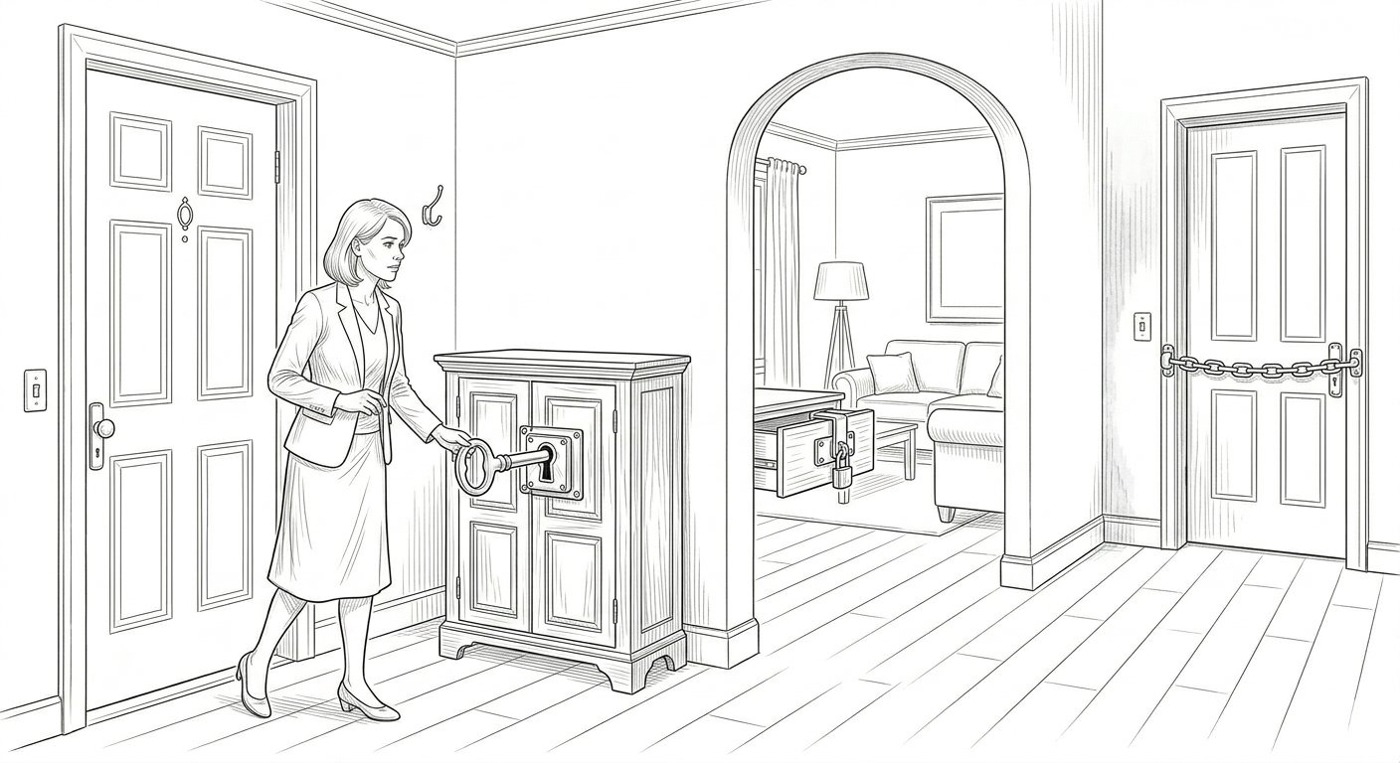
There used to be a key by the door.
Not the front door key. The spare one. The one that hung on a small hook in the hallway, available to the people who had been trusted with the knowledge of its existence. It was there for the neighbour who needed to let themselves in to water the plants. For the friend who was passing and wanted to leave something. For the family member who arrived before anyone was home. It was there because the host trusted the people who knew about it and the trust felt like a natural thing, an extension of the relationships that had made the key available in the first place.
At some point the key came down.
The host could not always tell you exactly when or exactly why. There was not a single incident that prompted it, usually. There was an accumulation. A thing that came back not quite right. A privacy that felt slightly less private than it had before. A small sense that the access that had been offered freely was being used more freely than it had been offered. The key did not come down in anger. It came down quietly, in the way that most self-protective decisions are made, without announcement and without explanation.
The cupboard that used to be open is locked now. Not because its contents changed. Because the host's relationship to who should be able to access them changed. The things that used to be left out are put away. The room that was always available for guests is now closed when guests are not there. The hospitality that was once offered with open hands has folded itself, slightly, into something more considered.
This is what happens when the trust that made the generosity possible has been used up faster than it could be replenished. The host did not become a different person. The host became a more careful version of the same person, which is what anyone becomes when the cost of openness has exceeded what the openness returned.
Some guests feel this as an accusation. They were not the one who opened the drawer. They would never open a drawer. And yet here they are, in a home that has started locking things, and the lock feels like it is aimed at them personally.
The host did not put the lock there for them. The host put the lock there for themselves. Because the home is theirs. Because what is inside the drawers is theirs. Because the decision about what gets shared, and when, and with whom, belongs entirely to the person who lives there and to no one else.
A locked cupboard is not an accusation. It is a boundary. The guest who reads it as an accusation has already told you something about what they would do if it were open.
Every home has its locks. But no lock has ever kept out what people carry inside themselves. The room, on any given evening, is a small world. And small worlds contain everything the large one does.